Key Insights & Memorable Quotes
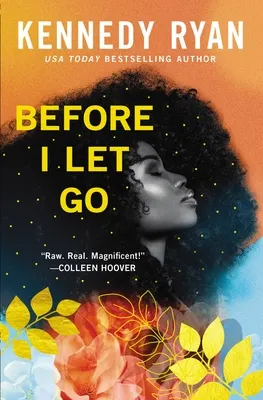
The most popular highlights from Before I Let Go, saved by readers on Screvi.
“Depression,” she goes on, “is a liar. If it will tell you no one loves you, that you’re not good enough, that you’re a burden or, in the most extreme cases, better off dead, then it can certainly convince you that you’re better off without the man you love, and that, ultimately, he’s better off without you.”
“You can’t change what has already happened. What you did or decided. So you have two choices. Wallow in it, stay in the chokehold of guilt and shame that holds you back from the next phase of your life”—she taps the pad with the pen—“or decide you’ve punished yourself long enough for things you can never change and set a date when you’ll forgive yourself and move forward.”
“Grief is a grind. It is the work of breathing and waking and rising and moving through a world that feels emptier. A gaping hole has been torn into your existence, and everyone around you just walks right past it like it’s not even there. But all you can do is stand and stare.”
“finding someone you can laugh with when everything hurts—was the stuff happily ever afters were made of.”
“I heard someone say once that when you try to fix people’s hurt, you’re controlling it instead of sitting with them and connecting.”
“I’ve fallen in love with the warrior woman who walked through fire, the one who came through stronger, reshaped by sorrow, reformed by grief, reborn in joy.”
“She’s not someone you banished with therapy and meds. She is you. You cannot dissociate from her. Until you reconcile that, you won’t find true peace. Until you have compassion for her instead of judgment, you cannot fully heal.”
“And I think I’m most grateful for time, which doesn’t always heal all wounds, but teaches us how to be happy again even with our scars.”
“My therapist says sometimes the people who are always keeping things together are the least prepared when they actually fall apart.”
“It begins with a tremor, a realization that love happens in the fragile context of our mortality. That love and life occur just beyond the reach of our control. There is only one letter of difference between love and lose, and somewhere along the way, for me they became synonymous. I understand now that something broke in me after my parents died that somehow healed wrong, and I started measuring how much I loved people in terms of how much it would hurt to lose them.”
“How do people do this? When the rug is pulled out from under the life the thought they would have forever, how do they pretend it's not seismic? That the roof hasn't fallen in and they're trapped under a concrete beam?”
“Our traumas, the things that injure us in this life, even over time, are not always behind us. Sometimes they linger in the smell of a newborn baby. They surprise us in the taste of a home-cooked meal. They wait in the room at the end of the hall. They are with us. They are present. And there are some days when memories feel more real than those who remain, than the joys of this world.”
“It means seeing myself clearly—good, bad, beautiful, ugly, faults, mistakes—acknowledging what I really think and feel, and not judging those emotions. Understanding myself. Not censoring it. Having compassion for myself.”
“That’s the part of depression people don’t consider, that at times it physically hurts.”
“Then she laughed and I wondered if this—finding someone you can laugh with when everything hurts—was the stuff happily ever afters were made of.”
“I was no walk in the park, Merry.” “Who wants to walk in the park? I think that man would run wild with you.”
“Funny how the words he doesn't say can sting more than the ones he does.”
“That,” she says, “is an irreversible outcome. Divorce may or may not be. Broken relationships may or may not be. You may never repair those completely, but you’re still here to try. Do you recognize what an amazing gift that is? To still be here to try?”
“We said till death do us part.” “Death is tearing us apart.”
“heard someone say once that when you try to fix people’s hurt, you’re controlling it instead of sitting with them and connecting. I didn’t have the words for it then, but I have language for it now.”
“I’ve learned that life isn’t about taking what you deserve, it’s about getting all you can while you can because it’s short. Because it’s fickle. Because it takes when we least expect it. Now everything I’ve lost makes me cherish the things I have, instead of always being afraid I’ll lose them.”
“Public grief is tricky to negotiate. At a certain point, and it varies depending on the person and circumstance, there comes a time when you should be “over it.” You should have moved on by now. And you’re so aware of the fact that you have not, that you cannot. You don’t want others to see your past-due tears or sense the pain that has outstayed its welcome. You protect them from feeling awkward because you’re still in pain. When the facade fails and you lose it, the stares soaked in sympathy are as bad as the ones filled with contempt.”
“If therapy has taught me anything, it’s that you run from your pain in a circle.”
“I think I’m most grateful for time, which doesn’t always heal all wounds, but teaches us how to be happy again even with our scars.”
“but understanding how you got hurt never makes it hurt less.”
“it wasn’t that I wanted to take my life,” she says. “But that I didn’t want to live it.”
“I miss him so much, sometimes I wear his shoes to feel close to him.”
“He pulls me against him for a quick kiss, taking a precious second to look at me, his eyes going gentler even in our race to set our clothes to rights. “We’ll talk tomorrow, okay?”
“The first time I saw her, my friends laughed because I stopped in the middle of whatever bullshit I was saying and stared.”
“Live long enough,” Dr. Musa says softly, “and you’ll lose people, things. We just need to learn how to deal with it in ways that aren’t isolating or destructive. You have to decide if being afraid of losing Yasmen again is worth never having her again.”
Find Another Book
Search by title or author to explore highlights from other books.
More Books You Might Like
Explore highlights from similar books.