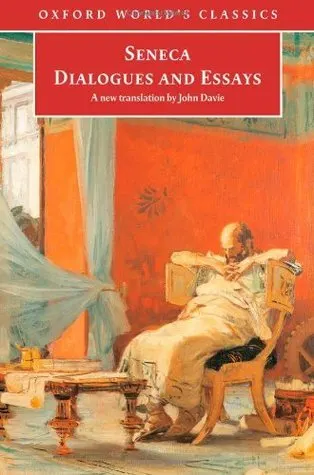
Key Insights & Memorable Quotes
The most popular highlights from Dialogues and Essays, saved by readers on Screvi.
“It is not what you endure that matters, but how you endure it.”
“The man who fears death will never do anything worthy of a man who is alive.”
“Wherever there is a human being, there exists the opportunity for an act of kindness.”
“Let us take pleasure in what we have received and make no comparison; no man will ever be happy if tortured by the greater happiness of another.”
“Those who forget the past, ignore the present, and fear for the future have a life that is very brief and filled with anxiety: when they come to face death, the wretches understand too late that for such a long time they have busied themselves in doing nothing.”
“It is better to conquer our grief than to deceive it. For if it has withdrawn, being merely beguiled by pleasures and preoccupations, it starts up again and from its very respite gains force to savage us. But the grief that has been conquered by reason is calmed for ever. I am not therefore going to prescribe for you those remedies which I know many people have used, that you divert or cheer yourself by a long or pleasant journey abroad, or spend a lot of time carefully going through your accounts and administering your estate, or constantly be involved in some new activity. All those things help only for a short time; they do not cure grief but hinder it. But I would rather end it than distract it.”
“The happy man is satisfied with his present situation, no matter what it is, and eyes his fortune with contentment; the happy man is the one who permits reason to evaluate every condition of his existence.”
“The man who fears death will never do anything worthy of a man who is alive; but he who knows that these were the conditions drawn up for him when he was conceived will live according to this rule and at the same time, through the same strength of mind, he will ensure that none of what happens to him will come unexpectedly.”
“What difference does it make whether they are slaves of free men, freeborn or freedmen, owing their freedom to the laws or to a gift made in the presence of friends? Wherever there is a human being, there exists the opportunity for an act of kindness.”
“When the lamp has been removed from my sight, and my wife, no stranger now to my habit, has fallen silent, I examine the whole of my day and retrace my actions and words; I hide nothing from myself, pass over nothing. For why should I be afraid of any of my mistakes, when I can say: ‘Beware of doing that again, and this time I pardon you.”
“Not all men are wounded in the same place; and so you ought to know what part of you is weak, so you can give it the most protection.”
“We live among wicked man through our own wickedness. One thing alone can bring us peace, an agreement to treat one another with kindness.”
“How much better it is that you defeat anger than that it defeats itself!”
“Anger will abate and become more controlled when it knows it must come before a judge each day.”
“Be aware, then, that every human condition is subject to change, and that whatever mishap can befall any man can also happen to you.”
“We must, therefore, take a less serious view of all things, tolerating them in a spirit of acceptance: It is more human to laugh at life than to weep tears over it.”
“Let Nature make whatever use she pleases of matter, which is her own: lets us be cheerful and brave in the face of all, and consider that nothing of our own perishes. What is the duty of a good man? To offer himself to fate.”
“we should often withdraw into ourselves; for mixing with persons of dissimilar natures throws into disorder our settled composure and wakens our passions anew, exacerbating whatever is weak in the mind and not properly healed.”
“A man should therefore grow accustomed to his state and complain about it as little as possible, seizing upon whatever good it may have.”
“No condition is so distressing that a balanced mind cannot find some comfort in it.”
“Your ears are not simply for hearing tuneful sounds, mellow and sweetly played in harmony: you should also listen to laughter and weeping, to words flattering and acrimonious, to merriment and distress, to the language of men and to the roars and barking of animals.”
“It is shameful to hate a person who deserves your praises; but how much more shameful it is to hate someone for the very cause that makes him deserve your pity.”
“Of all men only those who find time for philosophy are at leisure, only they are truly alive; for it is not only their own lifetime they guard well; they add every age to their own; all the years that have passed before them they requisition for their store.”
“Those who are busy with other things do not notice it until the end comes.”
“There is only one relief for great sufferings, and that is to endure and surrender to their compulsion.”
“The man who tries to find out what has been said against him, who seeks to unearth spiteful gossip, even when engaged in privately, is destroying his own peace of mind.”
“the other vices seize individuals, this is the one passion that sometimes takes hold of an entire state. Never has an entire people burned with love for a woman, no state in its entirety has placed its hope in money or profit; ambition seizes men one by one on a personal basis, lack of self-restraint does not afflict a whole people; often they rush to anger in one mass.”
“That very thing which is called dying, the soul’s departure from the body, is so brief that its swiftness cannot be perceived: whether a knot strangles your throat, or water stops you breathing, or you fall to the hard ground below and it crushes your skull, or flame you inhale cuts off the process of breathing: whatever it is, your end comes fast. Are you not blushing with shame? For so long you have dreaded what happens in a moment!”
“No one keeps himself waiting; and yet the greatest cure for anger is to wait, so that the initial passion it engenders may die down, and the fog that shrouds the mind may subside, or become less thick.”
“We always feel anger longer than we feel hurt.”
Find Another Book
Search by title or author to explore highlights from other books.
More Books You Might Like
Explore highlights from similar books.


