Key Insights & Memorable Quotes
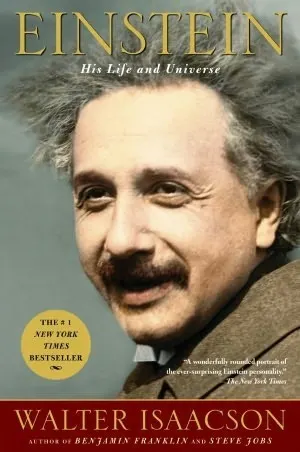
The most popular highlights from Einstein: His Life and Universe, saved by readers on Screvi.
The value of a college education is not the learning of many facts but the training of the mind to think, he [Einstein] said.
One of the strongest motives that leads men to art and science is escape from everyday life with its painful crudity and hopeless dreariness. Such men make this cosmos and its construction the pivot of their emotional life, in order to find the peace and security which they cannot find in the narrow whirlpool of personal experience.
To dwell on the things that depress or anger us does not help in overcoming them. One must knock them down alone.
A society’s competitive advantage will come not from how well its schools teach the multiplication and periodic tables, but from how well they stimulate imagination and creativity.
Life is like riding a bicycle. To keep your balance you must keep moving. —ALBERT EINSTEIN, IN A LETTER TO HIS SON EDUARD, FEBRUARY 5, 1930
How did he get his ideas? “I’m enough of an artist to draw freely on my imagination. Imagination is more important than knowledge. Knowledge is limited. Imagination encircles the world.
I believe that love is a better teacher than a sense of duty,” he said, “at least for me.
Politics is for the present, while our equations are for eternity.
I believe that the most important mission of the state is to protect the individual and to make it possible for him to develop into a creative personality,
He was a loner with an intimate bond to humanity, a rebel who was suffused with reverence. And thus it was that an imaginative, impertinent patent clerk became the mind reader of the creator of the cosmos, the locksmith of the mysteries of the atom and the universe.
It is tasteless to prolong life artificially,” he told Dukas. “I have done my share, it is time to go. I will do it elegantly.
Falling in love is not the most stupid thing that people do,” Einstein scribbled on the letter, “but gravitation cannot be held responsible for it.
The most beautiful emotion we can experience is the mysterious. It is the fundamental emotion that stands at the cradle of all true art and science. He to whom
If we want to resist the powers that threaten to suppress intellectual and individual freedom, we must be clear what is at stake,” he said. “Without such freedom there would have been no Shakespeare, no Goethe, no Newton, no Faraday, no Pasteur, no Lister.” Freedom was a foundation for creativity.
Blind respect for authority is the greatest enemy of truth.
By then Einstein had finally discovered what was fundamental about America: it can be swept by waves of what may seem, to outsiders, to be dangerous political passions but are, instead, passing sentiments that are absorbed by its democracy and righted by its constitutional gyroscope. McCarthyism had died down, and Eisenhower had proved a calming influence. “God’s own country becomes stranger and stranger,” Einstein wrote Hans Albert that Christmas, “but somehow they manage to return to normality. Everything—even lunacy—is mass produced here. But everything goes out of fashion very quickly.”9 Almost
science without religion is lame, religion without science is blind.
Imagination is more important than knowledge.
During the crossing, Einstein explained his theory to me every day, and by the time we arrived I was fully convinced that he really understands it.
Subtle is the Lord, but malicious he is not.”*
It was a sunny day, and Einstein merrily played with the telescope’s dials and instruments. Elsa came along as well, and it was explained to her that the equipment was used to determine the scope and shape of the universe. She reportedly replied, “Well, my husband does that on the back of an old envelope.
The value of a college education is not the learning of many facts but the training of the mind to think,
Einstein was asked what the next war would look like. “I do not know how the Third World War will be fought,” he answered, “but I can tell you what they will use in the Fourth—rocks.
When a person can take pleasure in marching in step to a piece of music it is enough to make me despise him. He has been given his big brain only by mistake.
Nationalism is an infantile disease, the measles of mankind.
What do you think of Adolf Hitler?” Einstein replied, “He is living on the empty stomach of Germany. As soon as economic conditions improve, he will no longer be important.
The most beautiful emotion we can experience is the mysterious. It is the fundamental emotion that stands at the cradle of all true art and science. He to whom this emotion is a stranger, who can no longer wonder and stand rapt in awe, is as good as dead, a snuffed-out candle. To sense that behind anything that can be experienced there is something that our minds cannot grasp, whose beauty and sublimity reaches us only indirectly: this is religiousness. In this sense, and in this sense only, I am a devoutly religious man.5 People
Use for yourself little,” he said, “but give to others much.”26
One day someone called the Institute and asked to speak to a particular dean. When his secretary said that the dean wasn’t available, the caller hesitantly asked for Einstein’s home address. That was not possible to give out, he was informed. The caller’s voice then dropped to a whisper. “Please don’t tell anybody,” he said, “but I am Dr. Einstein, I’m on my way home, and I’ve forgotten where my house is.”40
Since the mathematicians have grabbed hold of the theory of relativity, I myself no longer understand it.
Find Another Book
Search by title or author to explore highlights from other books.
More Books You Might Like
Explore highlights from similar books.


