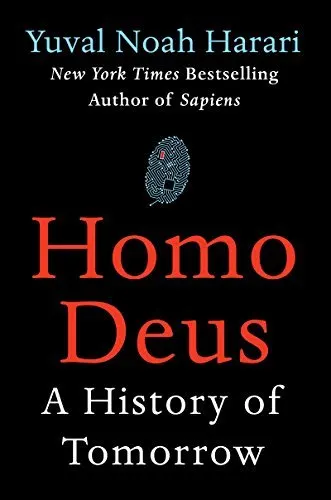
Key Insights & Memorable Quotes
The most popular highlights from Homo Deus: A History of Tomorrow, saved by readers on Screvi.
This is the best reason to learn history: not in order to predict the future, but to free yourself of the past and imagine alternative destinies. Of course this is not total freedom – we cannot avoid being shaped by the past. But some freedom is better than none.
We do not become satisfied by leading a peaceful and prosperous existence. Rather, we become satisfied when reality matches our expectations. The bad news is that as conditions improve, expectations balloon.
The most common reaction of the human mind to achievement is not satisfaction, but craving for more.
People are usually afraid of change because they fear the unknown. But the single greatest constant of history is that everything changes.
In 2012 about 56 million people died throughout the world; 620,000 of them died due to human violence (war killed 120,000 people, and crime killed another 500,000). In contrast, 800,000 committed suicide, and 1.5 million died of diabetes. Sugar is now more dangerous than gunpowder.
In the past, censorship worked by blocking the flow of information. In the twenty-first century, censorship works by flooding people with irrelevant information. [...] In ancient times having power meant having access to data. Today having power means knowing what to ignore.
The greatest scientific discovery was the discovery of ignorance. Once humans realised how little they knew about the world, they suddenly had a very good reason to seek new knowledge, which opened up the scientific road to progress.
History isn’t a single narrative, but thousands of alternative narratives. Whenever we choose to tell one, we are also choosing to silence others. Human
Keep the quotes that hit you. Save them to Screvi with this book's top highlights.
Save freeFiction isn't bad. It is vital. Without commonly accepted stories about things like money, states or corporations, no complex human society can function. We can't play football unless everyone believes in the same made-up rules, and we can't enjoy the benefits of markets and courts without similar make-believe stories. But stories are just tools. They shouldn't become our goals or our yardsticks. When we forget that they are mere fiction, we lose touch with reality. Then we begin entire wars `to make a lot of money for the cooperation' or 'to protect the national interest'. Corporations, money and nations exist only in our imagination. We invented them to serve us; why do we find ourselves sacrificing our life in their service.
Each and every one of us has been born into a given historical reality, ruled by particular norms and values, and managed by a unique economic and political system. We take this reality for granted, thinking it is natural, inevitable and immutable. We forget that our world was created by an accidental chain of events, and that history shaped not only our technology, politics and society, but also our thoughts, fears and dreams. The cold hand of the past emerges from the grave of our ancestors, grips us by the neck and directs our gaze towards a single future. We have felt that grip from the moment we were born, so we assume that it is a natural and inescapable part of who we are. Therefore we seldom try to shake ourselves free, and envision alternative futures.
Yet in truth the lives of most people have meaning only within the network of stories they tell one another.
Every day millions of people decide to grant their smartphone a bit more control over their lives or try a new and more effective antidepressant drug. In pursuit of health, happiness and power, humans will gradually change first one of their features and then another, and another, until they will no longer be human.
In essence, terrorism is a show. Terrorists stage a terrifying spectacle of violence that captures our imagination and makes us feel as if we are sliding back into medieval chaos. Consequently states often feel obliged to react to the theatre of terrorism with a show of security, orchestrating immense displays of force, such as the persecution of entire populations or the invasion of foreign countries. In most cases, this overreaction to terrorism poses a far greater threat to our security than the terrorists themselves. Terrorists
This is the paradox of historical knowledge. Knowledge that does not change behaviour is useless. But knowledge that changes behaviour quickly loses its relevance. The more data we have and the better we understand history, the faster history alters its course, and the faster our knowledge becomes outdated.
Soon, books will read you while you are reading them.
Sapiens rule the world because only they can weave an intersubjective web of meaning: a web of laws, forces, entities and places that exist purely in their common imagination. This web allows humans alone to organise crusades, socialist revolutions and human rights movements.
Keep the quotes that hit you. Save them to Screvi with this book's top highlights.
Save freeCapitalism did not defeat communism because capitalism was more ethical, because individual liberties are sacred or because God was angry with the heathen communists. Rather, capitalism won the Cold War because distributed data processing works better than centralised data processing, at least in periods of accelerating technological change.
Religion is a deal, whereas spirituality is a journey
The greatest scientific discovery was the discovery of ignorance.
Terrorists are like a fly that tries to destroy a china shop. The fly is so weak that it cannot budge even a single teacup. So it finds a bull, gets inside its ear and starts buzzing. The bull goes wild with fear and anger, and destroys the china shop. (p.21)
Traditionally, life has been divided into two main parts: a period of learning followed by a period of working. Very soon this traditional model will become utterly obsolete, and the only way for humans to stay in the game will be to keep learning throughout their lives, and to reinvent themselves repeatedly. Many if not most humans may be unable to do so.
If Kindle is upgraded with face recognition and biometric sensors, it can know what made you laugh, what made you sad and what made you angry. Soon, books will read you while you are reading them.
To attain real happiness, humans need to slow down the pursuit of pleasant sensations, not accelerate it.
If pupils suffer from attention disorders, stress and low grades, perhaps we ought to blame outdated teaching methods, overcrowded classrooms and an unnaturally fast tempo of life.
Keep the quotes that hit you. Save them to Screvi with this book's top highlights.
Save freeYou want to know how super-intelligent cyborgs might treat ordinary flesh-and-blood humans? Better start by investigating how humans treat their less intelligent animal cousins. It’s not a perfect analogy, of course, but it is the best archetype we can actually observe rather than just imagine.
The Theory of Relativity makes nobody angry because it doesn't contradict any of our cherished beliefs. Most people don't care an iota whether space and time are absolute or relative. If you think it is possible to bend space and time, well be my guest. ...In contrast, Darwin has deprived us of our souls. If you really understand the Theory of Evolution, you understand that there is no soul. This is a terrifying thought, not only to devote Christians and Muslims, but also to many secular people who don't hold any clear religious dogma, but nevertheless, want to believe that each human possess an eternal, individual essence that remains unchanged throughout life and can survive even death intact.
No clear line separates healing from upgrading. Medicine almost always begins by saving people from falling below the norm, but the same tools and know-how can then be used to surpass the norm.
Centuries ago human knowledge increased slowly, so politics and economics changed at a leisurely pace too. Today our knowledge is increasing at breakneck speed, and theoretically we should understand the world better and better. But the very opposite is happening. Our new-found knowledge leads to faster economic, social and political changes; in an attempt to understand what is happening, we accelerate the accumulation of knowledge, which leads only to faster and greater upheavals. Consequently we are less and less able to make sense of the present or forecast the future. In 1016 it was relatively easy to predict how Europe would look in 1050. Sure, dynasties might fall, unknown raiders might invade, and natural disasters might strike; yet it was clear that in 1050 Europe would still be ruled by kings and priests, that it would be an agricultural society, that most of its inhabitants would be peasants, and that it would continue to suffer greatly from famines, plagues and wars. In contrast, in 2016 we have no idea how Europe will look in 2050. We cannot say what kind of political system it will have, how its job market will be structured, or even what kind of bodies its inhabitants will possess.
The glass ceiling of happiness is held in place by two stout pillars, one psychological, the other biological. On the psychological level, happiness depends on expectations rather than objective conditions. We don’t become satisfied by leading a peaceful and prosperous existence. Rather, we become satisfied when reality matches our expectations. The bad news is that as conditions improve, expectations balloon. Dramatic improvements in conditions, as humankind has experienced in recent decades, translate into greater expectations rather than greater contentment. If we don’t do something about this, our future achievements too might leave us as dissatisfied as ever. On
If you want to see philosophy in action, pay a visit to a robo-rat laboratory. A robo-rat is a run-ofthe-mill rat with a twist: scientists have implanted electrodes into the sensory and reward areas in the rat’s brain. This enables the scientists to manoeuvre the rat by remote control. After short training sessions, researchers have managed not only to make the rats turn left or right, but also to climb ladders, sniff around garbage piles, and do things that rats normally dislike, such as jumping from great heights. Armies and corporations show keen interest in the robo-rats, hoping they could prove useful in many tasks and situations. For example, robo-rats could help detect survivors trapped under collapsed buildings, locate bombs and booby traps, and map underground tunnels and caves. Animal-welfare activists have voiced concern about the suffering such experiments inflict on the rats. Professor Sanjiv Talwar of the State University of New York, one of the leading robo-rat researchers, has dismissed these concerns, arguing that the rats actually enjoy the experiments. After all, explains Talwar, the rats ‘work for pleasure’ and when the electrodes stimulate the reward centre in their brain, ‘the rat feels Nirvana’.To the best of our understanding, the rat doesn’t feel that somebody else controls her, and she doesn’t feel that she is being coerced to do something against her will. When Professor Talwar presses the remote control, the rat wants to move to the left, which is why she moves to the left. When the professor presses another switch, the rat wants to climb a ladder, which is why she climbs the ladder. After all, the rat’s desires are nothing but a pattern of firing neurons. What does it matter whether the neurons are firing because they are stimulated by other neurons, or because they are stimulated by transplanted electrodes connected to Professor Talwar’s remote control? If you asked the rat about it, she might well have told you, ‘Sure I have free will! Look, I want to turn left – and I turn left. I want to climb a ladder – and I climb a ladder. Doesn’t that prove that I have free will?
Find Another Book
Search by title or author to explore highlights from other books.
More Books You Might Like
Explore highlights from similar books.


