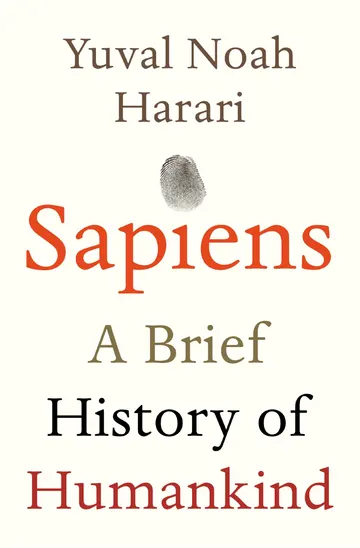
Key Insights & Memorable Quotes
The most popular highlights from Sapiens: A Brief History of Humankind, saved by readers on Screvi.
You could never convince a monkey to give you a banana by promising him limitless bananas after death in monkey heaven.
How do you cause people to believe in an imagined order such as Christianity, democracy or capitalism? First, you never admit that the order is imagined.
Culture tends to argue that it forbids only that which is unnatural. But from a biological perspective, nothing is unnatural. Whatever is possible is by definition also natural. A truly unnatural behaviour, one that goes against the laws of nature, simply cannot exist, so it would need no prohibition.
According to Buddhism, the root of suffering is neither the feeling of pain nor of sadness nor even of meaninglessness. Rather, the real root of suffering is this never-ending and pointless pursuit of ephemeral feelings, which causes us to be in a constant state of tension, restlessness and dissatisfaction. Due to this pursuit, the mind is never satisfied. Even when experiencing pleasure, it is not content, because it fears this feeling might soon disappear, and craves that this feeling should stay and intensify. People are liberated from suffering not when they experience this or that fleeting pleasure, but rather when they understand the impermanent nature of all their feelings, and stop craving them. This is the aim of Buddhist meditation practices. In meditation, you are supposed to closely observe your mind and body, witness the ceaseless arising and passing of all your feelings, and realise how pointless it is to pursue them. When the pursuit stops, the mind becomes very relaxed, clear and satisfied. All kinds of feelings go on arising and passing – joy, anger, boredom, lust – but once you stop craving particular feelings, you can just accept them for what they are. You live in the present moment instead of fantasising about what might have been. The resulting serenity is so profound that those who spend their lives in the frenzied pursuit of pleasant feelings can hardly imagine it. It is like a man standing for decades on the seashore, embracing certain ‘good’ waves and trying to prevent them from disintegrating, while simultaneously pushing back ‘bad’ waves to prevent them from getting near him. Day in, day out, the man stands on the beach, driving himself crazy with this fruitless exercise. Eventually, he sits down on the sand and just allows the waves to come and go as they please. How peaceful!
One of history’s few iron laws is that luxuries tend to become necessities and to spawn new obligations.
How many young college graduates have taken demanding jobs in high-powered firms, vowing that they will work hard to earn money that will enable them to retire and pursue their real interests when they are thirty-five? But by the time they reach that age, they have large mortgages, children to school, houses in the suburbs that necessitate at least two cars per family, and a sense that life is not worth living without really good wine and expensive holidays abroad. What are they supposed to do, go back to digging up roots? No, they double their efforts and keep slaving away.
Consistency is the playground of dull minds.
History is something that very few people have been doing while everyone else was ploughing fields and carrying water buckets.
Keep the quotes that hit you. Save them to Screvi with this book's top highlights.
Save freeBiology enables, Culture forbids.
We did not domesticate wheat. It domesticated us.
Money is the most universal and most efficient system of mutual trust ever devised.
The romantic contrast between modern industry that “destroys nature” and our ancestors who “lived in harmony with nature” is groundless. Long before the Industrial Revolution, Homo sapiens held the record among all organisms for driving the most plant and animal species to their extinctions. We have the dubious distinction of being the deadliest species in the annals of life.
This is the essence of the Agricultural Revolution: the ability to keep more people alive under worse conditions.
So, monotheism explains order, but is mystified by evil. Dualism explains evil, but is puzzled by order. There is one logical way of solving the riddle: to argue that there is a single omnipotent God who created the entire universe – and He’s evil. But nobody in history has had the stomach for such a belief.
As far as we can tell from a purely scientific viewpoint, human life has absolutely no meaning. Humans are the outcome of blind evolutionary processes that operate without goal or purpose. Our actions are not part of some divine cosmic plan, and if planet earth were to blow up tomorrow morning, the universe would probably keep going about its business as usual. As far as we can tell at this point, human subjectivity would not be missed. Hence any meaning that people inscribe to their lives is just a delusion.
happiness does not really depend on objective conditions of either wealth, health or even community. Rather, it depends on the correlation between objective conditions and subjective expectations.
Keep the quotes that hit you. Save them to Screvi with this book's top highlights.
Save freeThe capitalist and consumerist ethics are two sides of the same coin, a merger of two commandments. The supreme commandment of the rich is ‘Invest!’ The supreme commandment of the rest of us is ‘Buy!’ The capitalist–consumerist ethic is revolutionary in another respect. Most previous ethical systems presented people with a pretty tough deal. They were promised paradise, but only if they cultivated compassion and tolerance, overcame craving and anger, and restrained their selfish interests. This was too tough for most. The history of ethics is a sad tale of wonderful ideals that nobody can live up to. Most Christians did not imitate Christ, most Buddhists failed to follow Buddha, and most Confucians would have caused Confucius a temper tantrum. In contrast, most people today successfully live up to the capitalist–consumerist ideal. The new ethic promises paradise on condition that the rich remain greedy and spend their time making more money and that the masses give free reign to their cravings and passions and buy more and more. This is the first religion in history whose followers actually do what they are asked to do. How though do we know that we'll really get paradise in return? We've seen it on television.
Is there anything more dangerous than dissatisfied and irresponsible gods who don’t know what they want?
Nothing captures the biological argument better than the famous New Age slogan: ‘Happiness begins within.’ Money, social status, plastic surgery, beautiful houses, powerful positions – none of these will bring you happiness. Lasting happiness comes only from serotonin, dopamine and oxytocin.
Voltaire said about God that ‘there is no God, but don’t tell that to my servant, lest he murder me at night’. Hammurabi would have said the same about his principle of hierarchy, and Thomas Jefferson about human rights. Homo sapiens has no natural rights, just as spiders, hyenas and chimpanzees have no natural rights. But don’t tell that to our servants, lest they murder us at night.
How can we distinguish what is biologically determined from what people merely try to justify through biological myths? A good rule of thumb is ‘Biology enables, Culture forbids.’ Biology is willing to tolerate a very wide spectrum of possibilities. It’s culture that obliges people to realize some possibilities while forbidding others. Biology enables women to have children – some cultures oblige women to realize this possibility. Biology enables men to enjoy sex with one another – some cultures forbid them to realize this possibility. Culture tends to argue that it forbids only that which is unnatural. But from a biological perspective, nothing is unnatural. Whatever is possible is by definition also natural. A truly unnatural behavior, one that goes against the laws of nature, simply cannot exist.
Large numbers of strangers can cooperate successfully by believing in common myths. Any large-scale human cooperation – whether a modern state, a medieval church, an ancient city or an archaic tribe – is rooted in common myths that exist only in people’s collective imagination.
There are no gods, no nations, no money and no human rights, except in our collective imagination.
Each year the US population spends more money on diets than the amount needed to feed all the hungry people in the rest of the world.
Keep the quotes that hit you. Save them to Screvi with this book's top highlights.
Save freeWe study history not to know the future but to widen our horizons, to understand that our present situation is neither natural nor inevitable, and that we consequently have many more possibilities before us than we imagine.
Evolution has made Homo sapiens, like other social mammals, a xenophobic creature. Sapiens instinctively divide humanity into two parts, ‘we’ and ‘they’.
A meaningful life can be extremely satisfying even in the midst of hardship, whereas a meaningless life is a terrible ordeal no matter how comfortable it is.
in order to change an existing imagined order, we must first believe in an alternative imagined order.
One of history’s fews iron laws is that luxuries tend to become necessities and to spawn new obligations. Once people get used to a certain luxury, they take it for granted. Then they begin to count on it. Finally they reach a point where they can’t live without it. Over the few decades, we have invented countless time saving machines that are supposed to make like more relaxed - washing machines, vacuum cleaners, dishwashers, telephones, mobile phones, computers, email. We thought we were saving time; instead we revved up the treadmill of life to ten times its former speed and made our days more anxious and agitated.
Hierarchies serve an important function. They enable complete strangers to know how to treat one another without wasting the time and energy needed to become personally acquainted.
Find Another Book
Search by title or author to explore highlights from other books.
More Books You Might Like
Explore highlights from similar books.


