Key Insights & Memorable Quotes
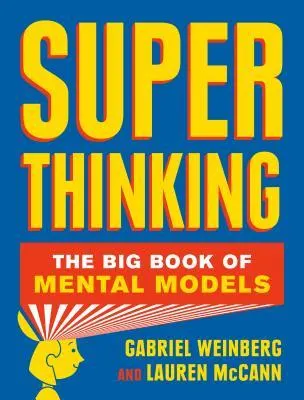
The most popular highlights from Super Thinking: The Big Book of Mental Models, saved by readers on Screvi.
Avoid succumbing to the gambler’s fallacy or the base rate fallacy. Anecdotal evidence and correlations you see in data are good hypothesis generators, but correlation does not imply causation—you still need to rely on well-designed experiments to draw strong conclusions. Look for tried-and-true experimental designs, such as randomized controlled experiments or A/B testing, that show statistical significance. The normal distribution is particularly useful in experimental analysis due to the central limit theorem. Recall that in a normal distribution, about 68 percent of values fall within one standard deviation, and 95 percent within two. Any isolated experiment can result in a false positive or a false negative and can also be biased by myriad factors, most commonly selection bias, response bias, and survivorship bias. Replication increases confidence in results, so start by looking for a systematic review and/or meta-analysis when researching an area.
High-stakes testing culture—be it for school examinations, job interviews, or professional licensing—creates perverse incentives to “teach to the test,” or worse, cheat.
The general model for this impact comes from economics and is called path dependence, meaning that the set of decisions, or paths, available to you now is dependent on your past decisions.
Campbell’s law) in his 1979 study, “Assessing the Impact of Planned Social Change.” He explains the concept a bit more precisely: “The more any quantitative social indicator is used for social decision-making, the more subject it will be to corruption pressures and the more apt it will be to distort and corrupt the social processes it is intended to monitor.
In fact, there is a mental model for this more specific situation, called the cobra effect, describing when an attempted solution actually makes the problem worse.
A related model to watch out for is the hydra effect, named after the Lernaean Hydra, a beast from Greek mythology that grows two heads for each one that is cut off. When you arrest one drug dealer, they are quickly replaced by another who steps in to meet the demand. When you shut down an internet site where people share illegal movies or music, more pop up in its place. Regime change in a country can result in an even worse regime.
If you do engage, another trap to watch out for is the observer effect, where there is an effect on something depending on how you observe it, or even who observes
The implication is that when people realized they were being watched by their governments, some of them stopped reading articles that they thought could get them into trouble. The name for this concept is chilling effect.
sustainable competitive advantage.
Sayre’s law, named after political scientist Wallace Sayre, offers that in any dispute the intensity of feeling is inversely proportional to the value of the issues at stake. A related concept is Parkinson’s law of triviality, named after naval historian Cyril Parkinson, which states that organizations tend to give disproportionate weight to trivial issues.
guerrilla warfare,
not ready for prime time.
punching above your weight.
The DRI concept helps avoid diffusion of responsibility, also known as the bystander effect, where people fail to take responsibility for something when they are in a group, because they think someone else will take on that responsibility. In effect, they act like bystanders, and the responsibility diffuses across all the members of the group instead of being concentrated in one person who is held accountable.
power vacuum. This mental model is an analogy to the natural concept of a vacuum, a space devoid of all substance, including air. If you make a vacuum, say by pumping air out of an empty container, and then you open that container, air will quickly rush into it, filling the vacuum, normalizing the air pressure. In
deliberate practice.
Don’t bring a knife to a gunfight.
spacing effect,
Pygmalion effect
guerrilla marketing,
nuclear option,
gateway drug theory,
loss leader strategy,
Deterrence, containment, and appeasement are
red line,
call your bluff,
hollow victory, sometimes referred to as an empty victory or Pyrrhic victory.
war of attrition,
endgame.
zero-tolerance policy,
Find Another Book
Search by title or author to explore highlights from other books.
More Books You Might Like
Explore highlights from similar books.