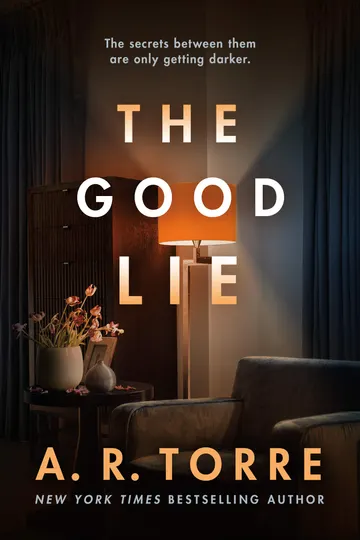
Key Insights & Memorable Quotes
The most popular highlights from The Good Lie, saved by readers on Screvi.
“William S. Burroughs once said that no one owns life, but anyone who can lift a frying pan can create death. He was right. Killing is the easy part. The act of living—of finding happiness in life—that’s the hard part. Moving past grief and guilt, and learning to love and to trust . . . I wanted to take that path, but I rather liked cradling my sorrows.”
“Obsession, as I frequently told my clients, never affected outside situations. They only made your internal struggles—and resulting personal actions and decisions—worse.”
“Losing a child was like losing a limb. You were reminded of it every time you moved, until the consistent adjustments to life became a permanent part of you.”
“Because he was good in bed? Trust me, the better the motion, the more screwed up the ocean.”
“You manipulate people for a living. Manipulation to fit and believe your narrative. You play with emotions and, sometimes, facts.”
“William S. Burroughs once said that no one owns life, but anyone who can lift a frying pan can create death. He was right. Killing is the easy part. The act of living—of finding happiness in life—that’s the hard part.”
“With this glass, rich and deep, we cradle all our sorrows to sleep.”
“We were a wrecked car, barreling down the highway without lights, our steering locked into place. I could put a seat belt on. I could reach out and jab the hazard lights on. But I couldn’t turn off the car, and I couldn’t seem to open the door and fling myself out.”
“Ha!” She laughed. “Honey, it’s not a life. It was a fart in a silent room. That’s why it made a big stink.”
“People have always fascinated me. Their motivations. Decisions. I like figuring out how their brains work.”
“You knew,” I said quietly. “You knew that John was the BH Killer.”
“Our part-time receptionist, who tuned pianos and ate shark-shaped gummy snacks for lunch,”
“He was lying. Had the first time, and still was. The conflicting evidence, previously dismissed by her, was starting to stack up. Just this morning, the attorney reminded them that they hadn’t found any of his DNA in Mr. Thompson’s trunk. Her patience snapped.”
“George’s theory was that Robert Kavin was bitter that Scott had lived and his son had died. He thought Kavin was punishing them because he’d lost Gabe, so he wanted to make Scott’s life hell.”
“He was a pervert. He told me about things he’d done. Girl students he raped.” There was a moment of silence as the room absorbed the new information. George put his arm around Nita and squeezed her to his side.”
“Why hadn’t he flagged down a car? Why had he run for miles, all the way home?”
“Then you have the attention seekers. They enjoy the power rush that comes from killing and want the media splash, the tearful families, the fear. They embrace the notoriety, the cat-and-mouse game with the police, the belief that they are outsmarting everyone.”
“It had been two weeks, and Scott felt fine enough to go in front of TV cameras, or chat with new followers on social media, yet he hadn’t returned a single message from his real friends.”
“He was frustratingly obtuse. Either unwilling or unable to comprehend the fact that he was facing a lifetime behind bars. A year ago, under the prior legislation, he’d have been a candidate for lethal injection.”
“Where had her motherly intuition been? How had it not screamed at her, with a giant glowing spotlight on his face?”
“the better the motion, the more screwed up the ocean.”
“With this glass, rich and deep, we cradle all our sorrows to sleep.” I gave a wistful smile.”
“Part of the game, for many killers, is the con of the innocent, the hiding of the monster,”
“William S. Burroughs once said that no one owns life, but anyone who can lift a frying pan can create death. He was right. Killing is the easy part. The act of living—of finding happiness in life—that’s the hard part. Moving past grief and guilt, and learning to love and to trust . . . I wanted to take that path, but I rather liked cradling my sorrows. I enjoyed the well of emotion, the proof that an empathic soul still existed in my aching chest. One day, I’d move on and forgive myself. I’d live a proper life. But for today, I just needed to survive.”
“William S. Burroughs once said that no one owns life, but anyone who can lift a frying pan can create death. He was right. Killing is the easy part. The act of living—of finding happiness in life—that’s the hard part.”
“It was a fart in a silent room. That’s why it made a big stink.”
“You know it’s weird, right? That you’re defending a man who is on trial for murdering your son?”
“You’re wasting money in hiring me. It doesn’t matter what psychological theories I give on the stand. They’re going to convict him.” Because he’s guilty.”
“The bindings, the rape, the naked bodies . . . it sounds sexual, but it’s more about making the victim feel helpless, which causes the killer to feel more in control.”
“The likeliest and easiest theory was that he was bullied by a boy very similar to the victim profile.”
Find Another Book
Search by title or author to explore highlights from other books.
More Books You Might Like
Explore highlights from similar books.