Key Insights & Memorable Quotes
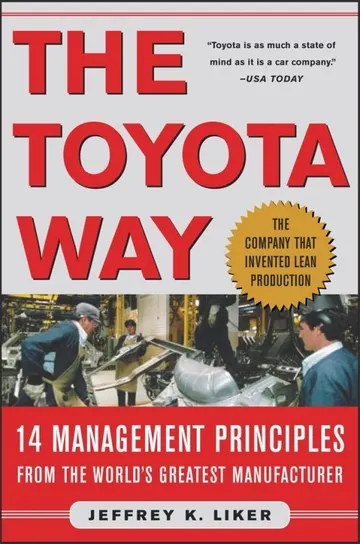
The most popular highlights from The Toyota Way: 14 Management Principles from the World's Greatest Manufacturer, saved by readers on Screvi.
Most Business Processes Are 90% Waste and 10% Value-Added Work
Every team member has the responsibility to stop the line every time they see something that is out of standard. That's how we put the responsibility for quality in the hands of our team members.
Go and see for yourself to thoroughly understand the situation (genchi genbutsu).
We build cars, not intellectuals
Standardization Is the Basis for Continuous Improvement and Quality
Andon works only when you teach your employees the importance of bringing problems to the surface so they can be quickly solved.
All we are doing is looking at the time line from the moment the customer gives us an order to the point when we collect the cash. And we are reducing that time line by removing the non-value-added wastes. (Ohno, 1988)
Be responsive to the day-by-day shifts in customer demand rather than relying on computer schedules and systems to track wasteful inventory.
The Toyota Production System can be realized only when all the workers become tortoises. (Ohno, 1988)
Automobiles account for about 20 percent of the carbon dioxide from all human sources, yet about one fourth of the world's population enjoys their benefits.
The Toyota Way, I introduced 14 principles of lean management organized around 4 Ps—philosophy, process, people, and problem solving.
Continuous improvement means getting better every day and is the driver for building a sustainable enterprise. Only those at the gemba can understand the problems fast enough to react quickly. Continuous improvement depends on a different paradigm of the role of the human—all humans are problem detectors and problem correctors—thinking scientifically.
A cornerstone of the Toyota Way is “challenge
We want organizations to be adaptive, flexible, self-renewing, resilient, learning, intelligent—attributes found only in living systems. The tension of our times is that we want our organizations to behave as living systems, but we only know how to treat them as machines. —Margaret J. Wheatley, author of Finding Our Way: Leadership for an Uncertain Time
So physically shifting from batch and queue operations (explained in greater detail later in the chapter) to one-piece flow without inventory almost guarantees you will encounter many more problems. So why do it? Precisely to allow the processes to break so we can discover the weak points and improve through kaizen.
It is comforting to believe that if we could only implement the right cells and other lean tools to eliminate waste in the process, we could let it rip and get great results forever . . . or at least for a long time. But processes do not work that way.
Exceptional People and Exceptional Processes Must Go Hand in Hand
the only thing that adds value in any type of process—be it in manufacturing, marketing, or a development process—is the physical or information transformation of that product, service, or activity into something the customer wants.
Source: Peter R. Scholtes, The Leader's Handbook, McGraw-Hill, 1998.
we create confusion so we have to do something different in approaching this problem.
This operational excellence is based in part on tools and quality improvement methods
«las medidas de contención en la raíz, llevan consigo el concepto de “esto y, aun así, esto otro”».
Figura 5-4. Objetivos «sin compromiso». 1. Alta velocidad, manejabilidad/estabilidad Y AUN ASÍ Una conducción agradable 2. Conducción rápida y suave Y AUN ASÍ Bajo consumo 3. Muy silencioso Y AUN ASÍ Peso ligero 4. Estilo elegante Y AUN ASÍ Gran aerodinámica 5. Acogedor Y AUN ASÍ Interior funcional 6. Gran estabilidad y alta velocidad Y AUN ASÍ Gran valor de CD
The most important factors for success are patience, a focus on long-term rather than short-term results, reinvestment in people, product, and plant, and an unforgiving commitment to quality. —Robert B. McCurry, former Executive VP, Toyota Motor Sales
Sakichi Toyoda’s personal and professional philosophy continues to influence Toyota today through what the company has distilled as his “five main principles”: 1. Always be faithful to your duties, thereby contributing to the company and to the overall good. 2. Always be studious and creative, striving to stay ahead of the times. 3. Always be practical and avoid frivolousness. 4. Always strive to build a homelike atmosphere at work that is warm and friendly. 5. Always have respect for spiritual matters and remember to be grateful at all times.
The Toyota Way provides a model for fast, efficient, and effective execution of long-term strategy based on: Carefully studying the market and planning in detail future products and services Putting safety first for team members and customers Eliminating wasted time and resources in execution of those plans Building quality into every step of design, manufacturing, and service delivery Using new technology effectively to work in harmony with people, not simply replace people Building a culture of people who learn and think scientifically to achieve aligned, challenging goals
Rather the power behind TPS is a company’s management commitment to continuously invest in its people and promote a culture of continuous improvement.
TPS starts with the customer. Always ask, “What value are we adding from the customer’s perspective?” Because the only thing that adds value in any type of process—be it a manufacturing, service, or development process—is the physical or information transformation of that product, service, or activity into something the customer wants.
In the abstract, science is hard to define, and there are endless philosophical debates over what it means. Rother is not focused as much on defining science per se, but rather on developing a practical approach to teaching people to think scientifically in everyday life. He describes it as:8 a mindset, or way of looking at the world/responding to goals and problems, that’s characterized by . . . Acknowledging that our comprehension is always incomplete and possibly wrong. Assuming that answers will be found by test rather than just deliberation. (You make predictions and test them with experiments.) Appreciating that differences between what we predict will happen and what actually happens can be a useful source of learning and corrective adjustment.
Mr. Ohba, who started the Toyota Production System Support Center (TSSC) in the United States. In a public presentation, he explained:† TPS is built on the scientific way of thinking. . . . How do I respond to this problem? Not a toolbox. [You have to be] willing to start small, learn through trial and error.
Find Another Book
Search by title or author to explore highlights from other books.
More Books You Might Like
Explore highlights from similar books.


