Key Insights & Memorable Quotes
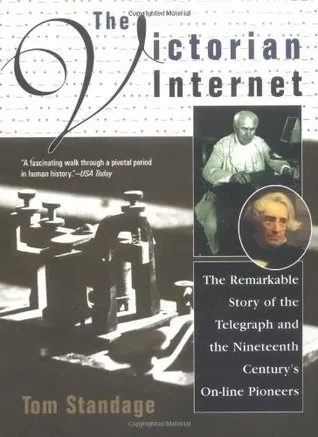
The most popular highlights from The Victorian Internet: The Remarkable Story of the Telegraph and the Nineteenth Century's On-line Pioneers, saved by readers on Screvi.
According to an account in Anecdotes of the Telegraph, when his request was questioned, the man ran off, "grinning a horrible, ghastly smile".
The exchange of consent being given by the electric flash, they were thus married by telegraph.
Chappe also had all sorts of ambitious plans for his invention; he hadn't intended its use to be so predominantly military in nature, and wanted to promote its employment in business.
Post Horses and Conveyances of every description may be ordered by the electric telegraph to be in readiness on the arrival of a train, at either Paddington or Slough Station.
He proposed a steam-powered pneumatic tube system to carry telegraph forms the short distance from the Stock Exchange to the main telegraph office.
A particularly important use of codes a was by banks. Worries about the security of telegraphic money transfers
In 1872, Western Union (by then the dominant telegraph company in the United States) decided to implement a new, secure scheme to enable sums of up to $100 to be transferred between several hundred towns by telegraph. The system worked by dividing the company's network into twenty districts, each of which had its own superintendent. A telegram from the sender's office to the district superintendent confirmed that the money had been deposited; the superintendent would then send another telegram to the recipient's office authorizing the payment. Both of these messages used a code based on numbered codebooks. Each telegraph office had one of these books, with pages containing hundreds of words. But the numbers next to these words varied from office to office; only the district superintendent had copies of each office's uniquely numbered book.
One writer, Gardiner Hubbard, described the American telegraph system as "peculiarly a business system; eighty per cent of the messages are on business matters… . the managers of the telegraph know that their business customers want the quickest and best service, and care more for dispatch than low tariffs. Thus the great difference between the telegraph systems of Europe and America is that [in Europe], the telegraph is used principally for social correspondence, here by businessmen for business purposes." The
Keep the quotes that hit you. Save them to Screvi with this book's top highlights.
Save freein Britain, for example, it meant that a centralized "nickname" system could be introduced. Under this scheme, companies and individuals could reserve a special word as their "telegraphic address" to make life easier for anyone who wanted to send them a telegram.
However, one listing of common abbreviations compiled in 1859 includes "1 1" (dot dot, dot dot) for "I AM READY"; "G A" (dash dash dot, dot dash) for "GO AHEAD", "S F D" for "STOP FOR DINNER"; "G M" for "GOOD MORNING.
Another milestone for the telegraph was when it was used to apprehend Fiddler Dick, a notorious pickpocket, and his gang. Their modus operandi involved robbing the crowds at a busy railway station and then escaping from the scene by train. Before the telegraph, there was no way to send information faster than a speeding train, so their getaway was assured. However, the presence of the telegraph alongside the Paddington-Slough line meant it was now possible to alert the police at the other end before the train’s arrival.
And one man in Nebraska thought the telegraph wires were a kind of tightrope; he watched the line carefully ‘‘to see the man run along the wires with the letter bags.
before long there were also pneumatic tube networks in Vienna, Prague, Munich, Rio de Janeiro, Dublin, Rome, Naples, Milan, and Marseilles. One of the most ambitious systems was installed in New York, linking many of the post offices in Manhattan and Brooklyn. This system was large enough to handle small parcels, and on one occasion a cat was even sent from one post office to another along the tubes.
Find Another Book
Search by title or author to explore highlights from other books.
More Books You Might Like
Explore highlights from similar books.