How to Keep a Reading Journal in 2026 (Setup, Prompts, and Ideas)
Most reading journals die in February.
Not because people stop reading, but because the journal asks too much: full reviews for every book, elaborate spreads copied from Pinterest, ratings across six categories. By the fourth book it feels like homework, and the notebook joins the drawer of abandoned notebooks.
A reading journal that survives the year does one job: it captures what a book meant to you while you still remember. Everything else is decoration. This guide covers the setup that works, what to actually write, and 20 prompts for when the page stares back.
What a reading journal is (and what it isn't)
A reading journal is a record of your reading life: the books, the passages that stopped you, and what you thought at the time. It's different from a book tracker, which counts and rates, and from a commonplace book, which collects quotes and ideas across everything you consume, not just books.
You don't need to pick a lane. Most good reading journals are part log, part quote collection, part diary. The mix is yours.
Pick a format you'll actually open
A plain notebook. Any notebook works. Bullet journal grids make spreads easier, but lined pages hold entries just as well. The advantage is friction in the good direction: writing by hand makes you choose what's worth keeping. The disadvantage is the same friction when you want to find a quote two years later.
A premade journal. Papier, Clever Fox, and similar publishers sell structured reading journals with pre-printed entry pages. Good if a blank page intimidates you, restrictive if your entries don't fit their boxes.
A notes app. Notion, GoodNotes, Apple Notes, or a folder of text files. Searchable, free, always with you. The catch: you still copy every quote by hand, and most digital journals quietly turn into paste dumps nobody rereads.
An automated journal. Apps like Screvi build the journal from your highlights: everything you mark on Kindle, Kobo, or Apple Books syncs into one library, and you add your notes on top. You write the thinking, not the transcription. More on this below.
If you're choosing between dedicated apps, we compared the main options in our book tracking apps guide.
The setup: four sections, nothing else
Skip the twelve-spread Pinterest setup. Four sections cover everything a reading journal needs to do:
1. The reading log. One line per book. Title, author, dates started and finished, and a rating if you want one. This is the section you'll show people.
2. The TBR list. Books you want to read, with one addition that changes everything: why you added each one. "Recommended by Ana after our argument about Steinbeck" is the difference between a TBR you use and a TBR that's just a guilt list.
3. Entries. The heart of the journal. One entry per book, written within a few days of finishing (or while reading, for long books). The structure below keeps entries under fifteen minutes.
4. Quotes. Passages worth keeping, with page numbers. Keep them with the entry or in their own section. This is the part that compounds: five years of collected passages is a book about you.
What to write in each entry
A repeatable structure beats inspiration. This one takes ten to fifteen minutes per book:
| Field | What goes there |
|---|---|
| Book, author, dates | The basics, one line |
| Where I was | What was happening in your life while you read it |
| The short version | The book's argument or story in two or three sentences, from memory |
| What stayed | The scene, idea, or sentence you kept thinking about |
| Pushback | One thing you disagreed with or didn't buy |
| Verdict | Who you'd give this book to, if anyone |
"Where I was" looks skippable. It isn't. Rereading an entry years later, the line about reading Project Hail Mary in a hospital waiting room will bring back more than any plot summary.
Write from memory first, then check the book. The act of retrieving the argument without looking is what moves it into long-term memory; copying the blurb does nothing.
20 reading journal prompts
For when you've finished a book and the page stays blank:
- What did this book change your mind about, even slightly?
- Which character would you least want to be stuck with, and why?
- What did the author leave out that you expected?
- Where did you almost quit, and what kept you going?
- What would you ask the author, given one question?
- Which passage would you read aloud to someone, and to whom?
- What did this book get wrong?
- What older book does this one secretly argue with?
- If the book had been 100 pages shorter, what should have gone?
- What will you have forgotten about it in a year?
- What did it make you want to read next?
- Where does it sit against the last book you read on the same subject?
- Which scene will you misremember, and how?
- What was the author afraid to say directly?
- Did the ending earn itself?
- What did you underline that you now think is obvious?
- What would your younger self have thought of this book?
- Which minor character deserved the spotlight?
- What's the one-sentence version you'd put in a group chat?
- Would you read it again, and at what point in your life?
You only need one per book. Pick whichever has an answer already forming.
The part nobody solves on paper: the quotes
Here's the honest failure mode of every paper and Notion journal: transcription.
You highlight thirty passages in a book. Copying them into the journal takes an hour, so you copy four and promise to do the rest later. Multiply by every book you read, and within a year your journal holds a fraction of what you marked, and the highlights themselves sit unread inside your Kindle.
This is the one part worth automating. Screvi syncs your Kindle, Kobo, and Apple Books highlights into one library, lets you capture passages from paper books by photographing the page, and attaches your notes to each one. Then it does what no notebook can: it resurfaces your highlights on a spaced repetition schedule, so the passages you saved in March come back to you in June, right when you're about to forget them.
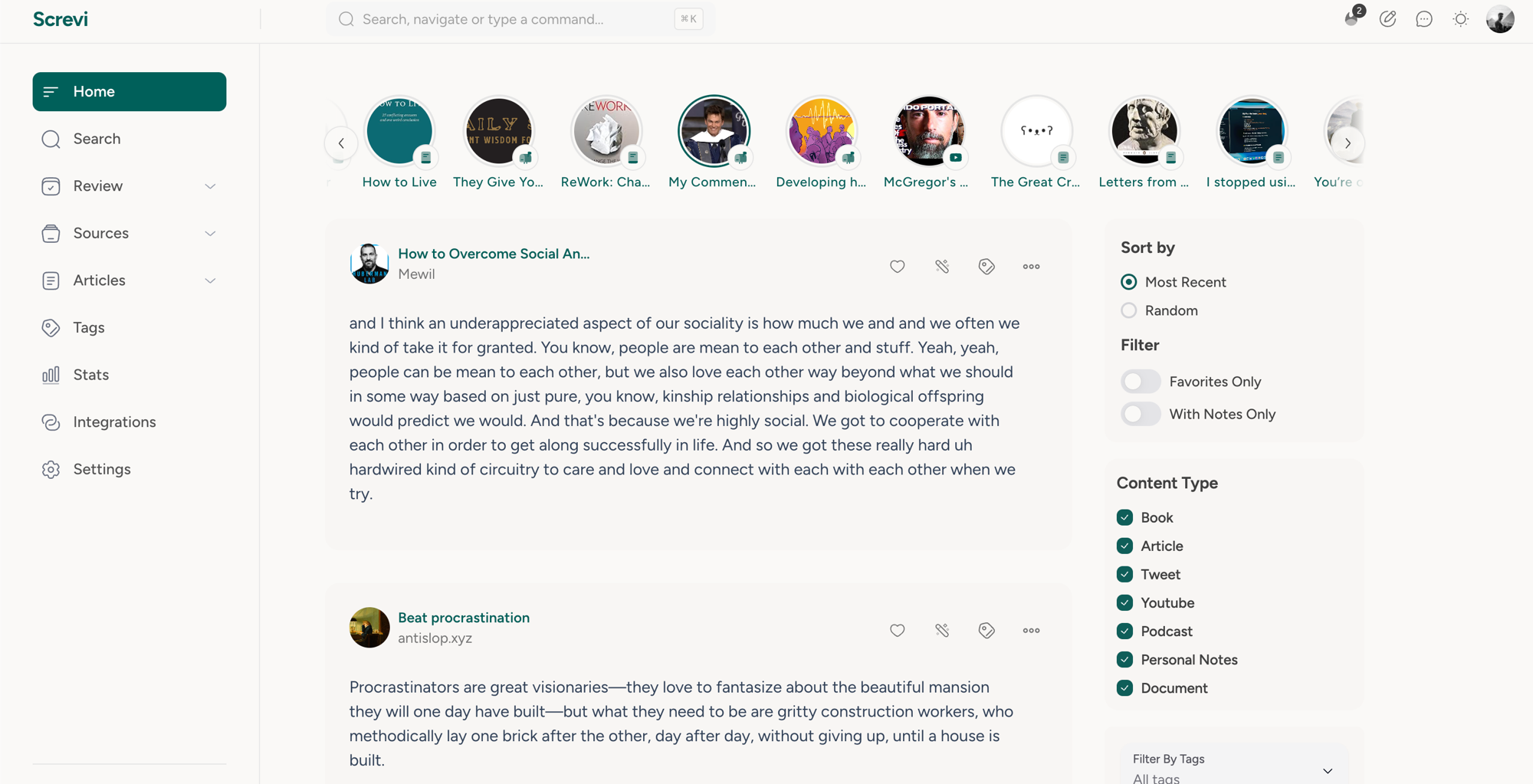
The journal entry stays yours to write. The collecting, organizing, and remembering runs by itself.
Keeping it alive past February
Three rules from journals that survive:
Lower the bar, keep the streak. A one-line entry is a valid entry. "Finished The Housemaid. Fun, forgettable, exactly what I needed this week" beats a blank page followed by three months of silence.
Journal the abandonments too. Books you quit deserve a line: what you hoped for, where it lost you. Half the value of a reading journal is the record of your taste changing, and DNFs chart that better than finishes.
Reread it. Set one date (New Year's works) to read the whole year's journal. This is the payoff that makes the habit self-sustaining, and the reason to keep entries honest instead of performative. Nobody's grading you.
A reading journal isn't about documenting books. It's about not losing the version of you that read them.