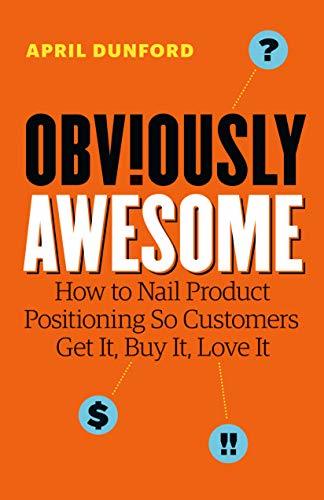
Key Insights & Memorable Quotes
The most popular highlights from Obviously Awesome: How to Nail Product Positioning so Customers Get It, Buy It, Love It, saved by readers on Screvi.
“Positioning is a business strategy exercise—the person who owns the business strategy needs to fully support the positioning, or it’s unlikely to be adopted. In startups, the head is the CEO and/or the founders. In larger companies, the head is usually the division or business unit leader and occasionally the head of marketing or head of product.”
“How do you beat Bobby Fischer? You play him at any game but chess.”
“Our users were generally database administrators, and their answers were typically quite specific and technical: “We just want to run a fast query” or “We have to produce a report, so we need to retrieve data from a very large database very quickly.” From those answers, I could assume they viewed our database as one that can quickly execute queries. But when we asked them what they would use if our database didn’t exist, none of them named another database; instead, they suggested business intelligence tools or data warehouses. Understanding the customer’s problem wasn’t enough—to really understand how they perceived our strengths and weaknesses, we needed to understand the alternatives to which they compared us. Customers always group solutions in categories, but talking to them about problems doesn’t necessarily reveal those categories.”
“However, if we sorted out just the best-fit customers, we could clearly see patterns.”
“There is only one thing stronger than all the armies of the world: and that is an idea whose time has come.” Victor Hugo”
“The next stage of the story is what I call “the perfect world.” It’s where you describe what the features of a perfect solution would be, knowing what you know about the problem and the limitations of current solutions. In our examples it would be something like, “In a perfect world, customers could complete the entire claims process seamlessly with their mobile device,” or “In a perfect world, small businesses could get the money they need quickly based on business they have already closed.”
“The future isn’t a place we are going to go, it’s a place we get to create.” Nancy Duarte”
“In general, your website, your sales and marketing materials, your pricing and even your immediate product roadmap will be designed to serve customers, and therefore should reflect your customer positioning not your investor positioning. Investors will understand that and will also understand that the story in your investor pitch deck may look dramatically different from the story in your sales deck.”
“we can either compete to win the entire market or position our product to win a slice of it. The “style” of positioning you choose will depend on a set of factors including the competitive landscape and your business goals.”
“An actionable segmentation captures a list of a person’s or company’s easily identifiable characteristics that make them really care about what you do. For consumers, a segmentation could include combinations of things such as other brands they own or like, stores they buy from, the job they hold or their music or entertainment preferences. For businesses, it could be the way they sell, other products they have invested in or the skills they have or don’t have inside their company.”
“keep in mind that most of your target customers have never heard of you or your rival startups—they simply want to know how your product compares to what they use today. Customer-facing positioning must be centered on a customer frame of reference.”
“first but it often has impacts well beyond that. Changing the way the company thinks about itself will usually have an impact on how product features get prioritized in the future.”
“The features of our product and the value they provide are only unique, interesting and valuable when a customer perceives them in relation to alternatives.”
“In the work I’ve done with startups, I’ve determined that it’s critical to start with understanding what the customer sees as a competitive alternative, and then working through the rest of the components—attributes, value, characteristics, market category, relevant trends—from there.”
“For those of us who make and sell products, the frame of reference that potential customers build around our offerings is critical to staying in business”
“Often a category emerges when an enabling technology, a shift in customer preferences and a supporting ecosystem manage to come together at once.”
“In the workshops I run, I set aside the first hour to go over positioning concepts and definitions with the team. At a minimum, the team needs to be on the same page regarding: What positioning means and why it is important Which components make up a position and how we define each of those How market maturity and competitive landscape impact the style of positioning you choose for a product”
“Attributes like “15-megapixel camera” or “all-metal construction” enable benefits for customers such as “sharper images” or “a stronger frame.” Articulating value takes the benefits one step further: putting benefits into the context of a goal the customer is trying to achieve. Value could be “photos that are sharp even when printed or zoomed in,” “a frame that saves you money on replacements,” “every level of the organization knows the status of key metrics” or “help is immediately available across every time zone.” Features enable benefits, which can be translated into value in unique customer terms.”
“Great positioning takes into account all of the following: The customer’s point of view on the problem you solve and the alternative ways of solving that problem. The ways you are uniquely different from those alternatives and why that’s meaningful for customers. The characteristics of a potential customer that really values what you can uniquely deliver. The best market context for your product that makes your unique value obvious to those customers who are best suited to your product.”
“Moving from “features” to “benefits” and then to “value” often confuses people, particularly folks who come from a technical background. An engineer by training, I often viewed features and the benefits derived from those features as interchangeable early in my career. For many consumer technical products, features are presented as valuable in their own right—but only because we do the translation to value automatically in our heads. For example, phone makers have often represented the quality of their cameras by talking about the number of megapixels. Consumers have been trained to translate megapixels to photo quality and therefore believe that cameras with more megapixels take better photos. Digging a bit deeper, the value of “better photos” for most consumers means sharper, more detailed images when printed or zoomed in.”
“In this step you need to stay focused on features and capabilities (also called attributes), rather than the value that those features drive for customers (we will get to that in Step 6). I define features as something your product or company has or does. Some examples of features: “a 15-megapixel camera,” “integrates with QuickBooks,” “one-click installation” and “metal construction.”
“It’s always better to be a little boring than completely baffling.”
“Timing is also important in creating a new category. To help customers make sense of why this category hasn’t emerged sooner, there should be a very strong answer to the questions, Why now? What factors have finally made this category possible and/or necessary? These might be new technology capabilities, a shift in buyer behavior, a change in the business environment such as new government regulations or a shift in the economy.”
“If you change the way you look at things, the things you look at change.” WAYNE DYER”
“We discovered that our philosophies were strikingly similar—we spent all our time looking for things that work, and then deciphering why.”
“The point of working through the sales story is that everyone in the discussion can agree on how the positioning translates into a “pitch.” To do that, the team needs to agree on how to define the problem, current solutions, the gap and the key purchase criteria that a customer should have when looking for a solution in your market.”
“Group attributes that provide similar value so you can get down to a more reasonable number. The goal of this step is to see the patterns and shorten the list to one to four value clusters. It’s not uncommon for this exercise to produce just a single value point.”
“Now, suppose that in your process of experimentation, you end up creating a cake that is actually quite small. It’s so small you could sell it as a self-contained, single-serving cake, so you put a little wrapper around it. You realize that you’ve actually made supreme chocolate muffins instead of better chocolate cake. At first it might not seem like this is much of a change. The product hasn’t changed much — it’s the same batter— but almost everything else about your business has. Why? Because we changed the mental frame of reference around the product from “cake” to “muffin.” That change in context changes everything about the business: Target buyers and where you sell. Unlike cakes, muffins are sold at coffee shops and diners. Competitive alternatives. You are now competing with donuts, Danishes and bagels. Pricing and margin. Muffins sell for a buck or two, and you will be looking to sell a lot of them. Key product features and roadmap. You are now fighting for the hearts and minds of a noble class of people who eat chocolate for breakfast. They’re likely not worried about gluten or the origin of the salt in your caramel. They might like your muffin larger or with more caramel or maybe they want it deep-fried like a hash brown (you might be laughing, but deep down I think you want to try one of those).”
“It’s no use of talking unless people understand what you say.” ZORA NEALE HURSTON”
“market. I want to leave you with some key takeaways: Any product can be positioned in multiple markets. Your product is not doomed to languish in a market where nobody understands how awesome it is. Great positioning rarely comes by default. If you want to succeed, you have to determine the best way to position your product. Deliberate, try, fail, test and try again. Understanding what your best customers see as true alternatives to your solution will lead you to your differentiators. Position yourself in a market that makes your strengths obvious to the folks you want to sell to. Use trends to make your product more interesting to customers right now, but be very cautious. Don’t layer on a trend just for the sake of being trendy—it’s better to be successful and boring, rather than fashionable and bewildering. Knowing how to do something is not the same as understanding how to teach someone else how to do it. As leaders, we often become very good at doing things that we have a very hard time explaining to the teams that work with us. This book is my attempt to codify and teach one of the most complicated processes I’ve learned to do in my career. I sincerely hope it offers you a shortcut to better position your products to succeed.”
Find Another Book
Search by title or author to explore highlights from other books.
More Books You Might Like
Explore highlights from similar books.