Key Insights & Memorable Quotes
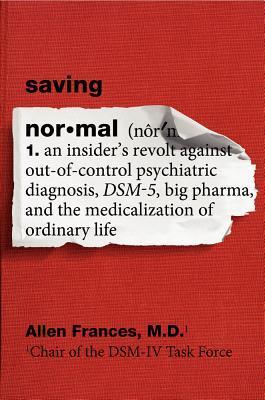
The most popular highlights from Saving Normal: An Insider's Revolt Against Out-Of-Control Psychiatric Diagnosis, DSM-5, Big Pharma, and the Medicalization of Ordinary Life, saved by readers on Screvi.
“The power to label is the power to destroy.”
“Loose diagnosis is causing a national drug overdose of medication. Six percent of our people are addicted to prescription drugs, and there are now more emergency room visits and deaths due to legal prescription drugs than to illegal street drugs.6”
“Stigma takes many forms, comes from all directions, is sometimes blatantly overt, but can also be remarkably subtle. It is the cruel comment, the unkind smirk, the extrusion from the group, the lost job opportunity, the rejected marriage proposal, the ineligibility for life insurance, the inability to adopt a child or pilot a plane. But it is also the reduced expectation, the helping hand when none is needed or wanted, the solicitous sympathy that one cannot really be expected to measure up.And the secondary psychological and practical harms of having a mental disorder come only partly from how others see you. A great deal of the trouble comes from the change in how you see yourself: the sense of being damaged goods, feeling not normal or worthy, not a full fledged member of the group.It is bad enough that stigma is so often associated with having a mental disorder, but the stigma that comes from being mislabeled with a fake diagnosis is a dead loss with absolutely no redeeming features.”
“Mental disorders should be diagnosed only when the presentation is clear-cut, severe, and clearly not going away on its own. The best way to deal with the everyday problems of living is to solve them directly or to wait them out, not to medicalize them with a psychiatric diagnosis or treat them with a pill.”
“[W]e have far too much faith in pills, far too little trust in resilience, time, and homeostasis.”
“[W]ay too much treatment is given to the normal "worried well" who are harmed by it; far too little help is available for those who are really ill and desperately need it. Two thirds of people with severe depression don't get treated for it, and many suffering with schizophrenia wind up in prisons. The writing is on the wall.”
“Overcoming problems on your own normalizes the situation, teaches new skills, and brings you closer to the people who were helpful. Taking a pill labels you as different and sick, even if you really aren't. Medication is essential when needed to reestablish homeostasis for those who are suffering from real psychiatric disorder. Medication interferes with homeostasis for those who are suffering from the problems of everyday life.”
“The great unspoken paradox of the arduous process of psychoanalysis is that the best patients are the ones who never really needed it in the first place. Abnormal”
“Taking a pill is passive. In contrast, psychotherapy puts the patient in charge by instilling new coping skills and attitudes toward life.”
“Patienthood can become a way of life and rationale for people who are struggling for other reasons.”
“Time heals so well because many of our ills are short-term, situational, and self-limited - our bodies and our minds are programmed to be resilient without any active effort on our part.”
“It is equally dangerous at either extreme - to have either an expanding concept of mental disorder that eliminates normal or to have an expanding concept of normal that eliminates mental disorder.”
“The DSMs have a mixed record. They have served an extremely valuable function in improving the reliability of psychiatric diagnosis and in encouraging a revolution in psychiatric research. But they have also had the very harmful unintended consequence of triggering and helping to maintain a runaway diagnostic inflation that threatens normal and results in massive overtreatment with psychiatric medication.”
“ADHD is spreading like wildfire. It used to be confined to a small percentage of kids who had clear-cut problems that started at a very early age and caused them unmistakable difficulties in many situations. Then all manner of classroom disruption was medicalized and ADHD was applied so promiscuously that an amazing 10 percent of kids now qualify.”
“DSM definitions do not include personal and contextual factors such as whether the depressive symptoms are an understandable response to loss, a terrible life situation, psychological conflict or personality factors.”
“I sometimes joke that the only way to define mental disorder is “that which clinicians treat; researchers research; educators teach; and insurance companies pay for.”
“The absence of biological tests is a huge disadvantage for psychiatry. It means that all of our diagnoses are now based on subjective judgments that are inherently fallible and prey to capricious change.”
“Disease mongering cannot occur in a vacuum—it requires that the drug companies engage the active collaboration of the doctors who write the prescriptions, the patients who ask for them, the researchers who invent the new mental disorders, the consumer groups that advocate for more treatment, and the media and Internet that spread the word.”
“Can the bell curve provide a scientific guide in deciding who is mentally normal and who is not? Conceptually, the answer is “why not,” but practically the answer is “hell no.”
“Elusive reality does not discourage Umpire Two. We don’t have to fully perceive or understand the underlying nature of our world to negotiate it well. Our senses and reasoning powers evolved as they did because they work just fine in the everyday, nonphilosophical business of survival. Mental constructs of reality are imperfect, but indispensable, ways to organize the otherwise bewildering phenomena of the world.”
“We still do not have a single laboratory test in psychiatry. Because there is always more variability in the results within the mental disorder category than between it and normal or other mental disorders,”
“Utilitarianism provided the first, and remains the only practical, philosophic guidance on how and where to set a boundary between “normal” and “mental disorder.”
“Diagnostic inflation has led to an explosive growth in the use of psychotropic drugs; this then produced huge profits that have given the pharmaceutical industry the means and the motive to blow up the diagnostic bubble into an ever-expanding balloon.”
“It is good to know and use the DSM definitions, but not to reify or worship them.31,32”
“we neglect what are the best forms of prevention—i.e., promoting exercise, proper diet, moderation in alcohol use, abstention from tobacco and drugs. These extremely useful and remarkably cheap prevention measures aren’t profitable for the medical-industrial complex and therefore lack its powerful and well-financed sponsorship.”
“CBD has become the most inflated bubble in all of psychiatric diagnosis, with a remarkable fortyfold inflation in just one decade. CBD satisfied three essential preconditions for excessive popularity: a pressing need, influential prophets, and an engaging story.”
“If there are just a few mental health clinicians in a developing country, only the most severely disturbed will appear mentally disordered—”
“Much of the increased prevalence of ADHD results from the “false positive” misidentification of kids who would be better off never receiving a diagnosis. Drug company marketing pressure often leads to unnecessary treatment with medications that can cause the harmful side effects of insomnia, loss of appetite, irritability, heart rhythm problems, and a variety of psychiatric symptoms.”
“Utilitarianism provided the first, and remains the only practical, philosophic guidance on how and where to set a boundary between “normal” and “mental disorder.” The guiding assumptions are that “normal” has no universal meaning and can never be defined with precision by the spinning wheels of philosophical deduction—it is very much in the eye of the beholder and is changeable over time, place, and cultures. From this it follows that the boundary separating “normal” from “mental disorder” should be based not on abstract reasoning, but rather on the balance between the positive and the negative consequences that accrue from different choices. Always seek the “greatest good for the greatest number.”
“the drug companies had to get an indication for bipolar disorder and then they had to advertise a conception of bipolar disorder so broad as to be unrecognizable. Antipsychotics were soon being prescribed promiscuously, even by primary care physicians, to patients with garden-variety anxiety, sleeplessness, and irritability.”
Find Another Book
Search by title or author to explore highlights from other books.
More Books You Might Like
Explore highlights from similar books.