Key Insights & Memorable Quotes
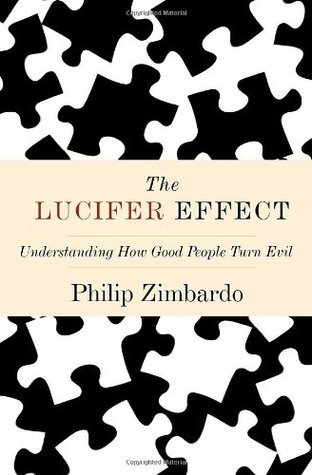
The most popular highlights from The Lucifer Effect: Understanding How Good People Turn Evil, saved by readers on Screvi.
“The most dramatic instances of directed behavior change and "mind control" are not the consequence of exotic forms of influence, such as hypnosis, psychotropic drugs, or "brainwashing," but rather the systematic manipulation of the most mundane aspects of human nature over time in confining settings.”
“Sticks and stones can break your bones, but names can kill you.”
“Fear is the State's psychological weapon of choice to frighten citizens into sacrificing their basic freedoms and rule-of-law protections in exchange for the security promised by their all-powerful government.”
“Jerry-5486: "The most apparent thing that I noticed was how most of the people in this study derive their sense of identity and well-being from their immediate surroundings rather than from within themselves, and that's why they broke down—just couldn't stand the pressure—they had nothing within them to hold up against all of this.”
“Majority decisions tend to be made without engaging the systematic thought and critical thinking skills of the individuals in the group. Given the force of the group's normative power to shape the opinions of the followers who conform without thinking things through, they are often taken at face value. The persistent minority forces the others to process the relevant information more mindfully. Research shows that the deciscions of a group as a whole are more thoughtful and creative when there is minority dissent than when it is absent.”
“Before I knew that a man could kill a man, because it happens all the time. Now I know that even the person with whom you've shared food, or whom you've slept, even he can kill you with no trouble. The closest neighbor can kill you with his teeth: that is what I have Learned since the genocide, and my eyes no longer gaze the same on the face of the world.”
“Evil consists in intentionally behaving in ways that harm, abuse, demean, dehumanize, or destroy innocent others—or using one’s authority and systemic power to encourage or permit others to do so on your behalf. In short, it is “knowing better but doing worse”.”
“Our personal identities are socially situated. We are where we live, eat, work, and make love. [...]Our sense of identity is in large measure conferred on us by others in the ways they treat or mistreat us, recognize or ignore us, praise us or punish us. Some people make us timid and shy; others elicit our sex appeal and dominance. In some groups we are made leaders, while in others we are reduced to being followers. We come to live up to or down to the expectations others have of us. The expectations of others often become self-fulfilling prophecies. Without realizing it, we often behave in ways that confirm the beliefs others have about us. Those subjective beliefs create new realities for us. We often become who other people think we are, in their eyes and in our behavior.”
“Our ability to selectively engage and disengage our moral standards . . . helps explain how people can be barbarically cruel in one moment and compassionate the next. —Albert Bandura20”
“When a power elite wants to destroy an enemy nation, it turns to propaganda experts to fashion a program of hate. What does it take for the citizens of one society to hate the citizens of another society to the degree that they want to segregate them, torment them, even kill them? It requires a “hostile imagination,” a psychological construction embedded deeply in their minds by propaganda that transforms those others into “The Enemy.” That image is a soldier’s most powerful motive, one that loads his rifle with ammunition of hate and fear. The image of a dreaded enemy threatening one’s personal well-being and the society’s national security emboldens mothers and fathers to send sons to war and empowers governments to rearrange priorities to turn plowshares into swords of destruction.”
“Most of us perceive Evil as an entity, a quality that is inherent in some people and not in others. Bad seeds ultimately produce bad fruits as their destinies unfold. . . Upholding a Good-Evil dichotomy also takes ‘good people’ off the responsibility hook. They are freed from even considering their possible role in creating, sustaining, perpetuating, or conceding to the conditions that contribute to delinquency, crime, vandalism, teasing, bullying, rape, torture, terror, and violence.”
“We mortals can be fools, especially when mortal emotions rule over cool reason.”
“each of us has the potential, or mental templates, to be saint or sinner, altruistic or selfish, gentle or cruel, submissive or dominant, sane or mad, good or evil. Perhaps we are born with a full range of capacities, each of which is activated and developed depending on the social and cultural circumstances that govern our lives. I”
“Our sense of power is more vivid when we break a man’s spirit than when we win his heart. —Eric Hoffer, The Passionate State of Mind (1954)”
“Bad systems” create “bad situations” create “bad apples” create “bad behaviors,” even in good people.”
“A good way to avoid crimes of obedience is to assert one’s personal authority and always take full responsibility for one’s actions.23”
“Evil that arises out of ordinary thinking and is committed by ordinary people is the norm, not the exception.”
“Aleksandr Solzhenitsyn: “The line between good and evil is in the center of every human heart.”
“Evil consists in intentionally behaving in ways that harm, abuse, demean, dehumanize, or destroy innocent others—or using one’s authority and systemic power to encourage or permit others to do so on your behalf.”
“It is when power is wedded to chronic fear that it becomes formidable. —Eric Hoffer, The Passionate State of Mind”
“Heroism can be defined as having four key features: (a) it must be engaged in voluntarily; (b) it must involve a risk or potential sacrifice, such as the threat of death, an immediate threat to physical integrity, a long-term threat to health, or the potential for serious degradation of one’s quality of life; (c) it must be conducted in service to one or more other people or the community as a whole; and(d) it must be without secondary, extrinsic gain anticipated at the time of the act. Heroism in service of a noble idea is usually not as dramatic as”
“The fundamental human need to belong comes from the desire to associate with others, to cooperate, to accept group norms. However, the SPE shows that the need to belong can also be perverted into excessive conformity, compliance, and in-group versus out-group hostility. The need for autonomy and control, the central forces toward self-direction and planning, can be perverted into an excessive exercise of power to dominate others or into learned helplessness.”
“conditions that make us feel anonymous, when we think that others do not know us or care to, can foster antisocial, self-interested behaviors. My”
“However, even psychologists are people, subject to the same dynamic processes at a personal level that they study at a professional level.”
“Power said to the world, “You are mine.” The world kept it prisoner on her throne. Love said to the world, “I am thine.” The world gave it the freedom of her house. —Rabindranath Tagore, Stray Birds22”
“recognizing the early signs of toxicity in our leaders can enable us to take preventive medicine, not passively imbibe their seductive poison.33”
“Most of us hide behind egocentric biases that generate the illusion that we are special.”
“humanity can be transformed by power and by powerlessness. Underlying”
“diffusion of responsibility, in any form it takes, lowers the inhibition against harming others.”
“Another way of looking at it is, you’re putting good people in an evil situation to see who or what wins.”
Find Another Book
Search by title or author to explore highlights from other books.
More Books You Might Like
Explore highlights from similar books.


