Key Insights & Memorable Quotes
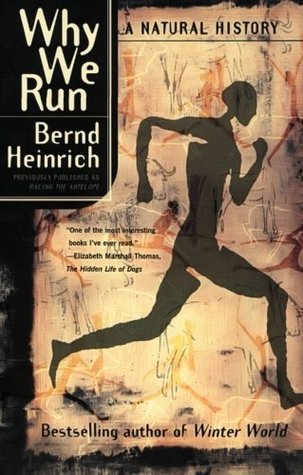
The most popular highlights from Why We Run: A Natural History, saved by readers on Screvi.
“There is nothing quite so gentle, deep, and irrational as running--and nothing quite so savage, so wild.”
“Barry L. Jacobs and colleagues from the neuroscience program at Princeton University showed that when mice ran every day on an exercise wheel, they developed more brain cells and they learned faster than sedentary controls. I believe in mice.”
“In order to forge alliances, we first need worthy adversaries. Without adversaries, no alliances are necessary.”
“Running is perhaps the most fundamental of all sports, and it is economically the least costly to perform. As a consequence, it is the most democratic and most competitive of all sports because individual merit can prevail despite economic equality. It is a sport for everyone, the whole world over.”
“Every morning in Africa, an antelope wakes up. It knows it must outrun the fastest lion, or it will be killed. Every morning in Africa, a lion wakes up. It knows it must run faster than the fastest antelope, or it will starve. It doesn’t matter whether you’re a lion or an antelope—when the sun comes up, you’d better be running.”
“We need to take exercise, and vitamins, when our normal life styles, and diet, are at odds with the ancestral conditions that shaped us.”
“Ask now the beasts, and they shall teach thee. —JOB 12:7”
“America is an experiment,' he said, and after a long pause continued, 'where the driving force is individuals chasing money. I would not risk my bones for a society guided by this principle.”
“Every parting gives a foretaste of death, every reunion a hint of resurrection. —ARTHUR SCHOPENHAUER, German philosopher”
“Hunting by chimps and baboons is largely secondary to other foraging, but prey is almost routinely taken as opportunity affords.”
“I did not have to be like anyone else, an important lesson for life.”
“The fact that we, as savanna-adapted animals, have such a hypertrophied sweating response implies that if we are naturally so profligate with water, it can only be because of some very big advantage. The most likely advantage was that it permitted us to perform prolonged exercise in the heat.”
“The camel’s erythrocytes (red blood cells) are uniquely oval shaped and small, reducing blood viscosity and permitting circulation through the capillaries despite fluid loss.”
“Like other animals, we play at those things that are important to our survival, and social play promotes social cohesion.”
“By about 2 to 3 million years ago, the bipedal plains hominids already had a leg and foot structure almost identical to our own.”
“Camels suffer no ill effects from overdrinking; the camel’s blood cells can swell up to 240 percent without rupturing.”
“One of the beautiful things about running is that it is direct and elegant. The formula is simple: put one foot in front of the other. It doesn’t take much to figure out that if you want to improve sprint speed, you run faster. If you want to improve distance-running performance, you run farther.”
“Every morning in Africa, an antelope wakes up. It knows it must outrun the fastest lion, or it will be killed.”
“Given the camel’s example, an ultramarathoner who remains vertical in the heat should have long head hair or wear a hat, and shield his body with loose clothing. Frequent small drinks are better than tanking up, because we lack the camel’s water-balance adaptations, being instead evolved for more speed at the cost of greater water loss.”
“I’m moved by others’ dreams and by their devotion and courage in the pursuit of excellence. I get choked up when I see a kid, or anyone else, fighting hopeless odds—someone who goes out there to run the lonely roads with a dream in the heart, a gleam in the eye, and a goal in mind.”
“I retained little from the textbooks, learning instead from what I lived and the things I touched that held emotional content for me.”
“dire wolves”
“Because simply shooting animals is not hunting at all. Not even close.”
“You don't get anywhere by magic, but only by putting in the required number of steps. (...) There is a truth, a beauty, and a symmetry in this that is inviolate. Every step counts. Each is an act of beauty. Together they create stride, and in terms of the whole, pace.”
“Any mark of difference may become a target.”
“Animals are consummately pro-choice. Their bodies commit to the massive task of reproduction only when the resources to pull it off are available.”
“Euglena”
“There may be no more compelling goal than a close one, but there is none more lasting than a distant one not yet attained.”
“talent lies not in our genes but in our minds.”
“The Khoisan people of Southern Africa (Hottentots and Bushmen) were well known for being able to run down swift prey, including steenboks, gemsboks, wildebeests, and zebras, provided they could hunt in the heat of the day. The Tarahumara Indians of northern Mexico chase down deer till the animals are exhausted, then throttle them to death by hand. The Paiutes and Navajos were reported to do the same with pronghorn antelopes. Australian Aborigines chase down kangaroos, but only by forcing them to reach lethal body temperatures.”
Find Another Book
Search by title or author to explore highlights from other books.
More Books You Might Like
Explore highlights from similar books.