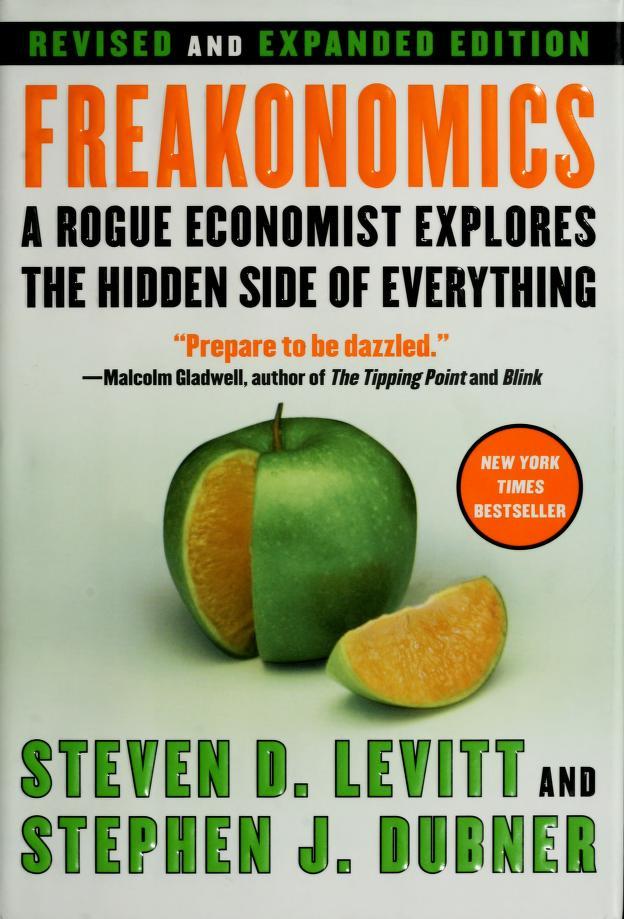
Key Insights & Memorable Quotes
The most popular highlights from Freakonomics: A Rogue Economist Explores the Hidden Side of Everything, saved by readers on Screvi.
Morality, it could be argued, represents the way that people would like the world to work, wheareas economics represents how it actually does work.
The conventional wisdom is often wrong.
Information is a beacon, a cudgel, an olive branch, a deterrent--all depending on who wields it and how.
As W.C. Fields once said: a thing worth having is a thing worth cheating for.
An incentive is a bullet, a key: an often tiny object with astonishing power to change a situation
After all, your chances of winning a lottery and of affecting an election are pretty similar. From a financial perspective, playing the lottery is a bad investment. But it's fun and relatively cheap: for the price of a ticket, you buy the right to fantasize how you'd spend the winnings - much as you get to fantasize that your vote will have some impact on policy.
If you both own a gun and a swimming pool in your backyard, the swimming pool is about 100 times more likely to kill a child than the gun is.
Social scientists sometimes talk about the concept of "identity". It is the idea that you have a particular vision of the kind of person you are, and you feel awful when you do things that are out of line with that vision.
When a woman does not want to have a child, she usually has good reason. She may be unmarried or in a bad marriage. She may consider herself too poor to raise a child. She may think her life is too unstable or unhappy, or she may think that her drinking or drug use will damage the baby’s health. She may believe that she is too young or hasn’t yet received enough education. She may want a child badly but in a few years, not now. For any of a hundred reasons, she may feel that she cannot provide a home environment that is conducive to raising a healthy and productive child.
There are three basic flavors of incentive: economic, social, and moral. Very often a single incentive scheme will include all three varieties. Think about the anti-smoking campaign of recent years. The addition of a $3-per-pack “sin tax” is a strong economic incentive against buying cigarettes. The banning of cigarettes in restaurants and bars is a powerful social incentive. And when the U.S. government asserts that terrorists raise money by selling black-market cigarettes, that acts as a rather jarring moral incentive.
A rogue economist explores the hidden side of everything.
But as incentives go, commissions are tricky. First of all, a 6 percent real-estate commission is typically split between the seller’s agent and the buyer’s. Each agent then kicks back roughly half of her take to the agency. Which means that only 1.5 percent of the purchase price goes directly into your agent’s pocket. So on the sale of your $300,000 house, her personal take of the $18,000 commission is $4,500. Still not bad, you say. But what if the house was actually worth more than $300,000? What if, with a little more effort and patience and a few more newspaper ads, she could have sold it for $310,000? After the commission, that puts an additional $9,400 in your pocket. But the agent’s additional share—her personal 1.5 percent of the extra $10,000—is a mere $150. If you earn $9,400 while she earns only $150, maybe your incentives aren’t aligned after all.
An expert must be BOLD if he hopes to alchemize his homespun theory intoconventional wisdom.
Knowing what to measure and how to measure it makes a complicated world much less so.
For emotion is the enemy of rational argument.
Despite spending more time with themselves than with any other person, people often have surprisingly poor insight into their skills and abilities.
The ECLS data do show, for instance, that a child with a lot of books in his home tends to test higher than a child with no books.
A woman's income appeal is a bell-shaped curve: men do not want to date low-earning women, but once a woman starts earning too much, they seem to be scared off.
Experts depend on the fact that you don’t have the information they do. Or that you are so befuddled by the complexity of their operation that you wouldn’t know what to do with the information if you had it. Or that you are so in awe of their expertise that you wouldn’t dare challenge them.
Congress passed legislation requiring a five-year mandatory sentence for selling just five grams of crack; you would have to sell 500 grams of powder cocaine to get an equivalent sentence. This disparity has often been called racist, since it disproportionately imprisons blacks.
It is well and good to opine or theorize about a subject, as humankind is wont to do, but when moral posturing is replaced by an honest assessment of the data, the result is often a new, surprising insight.
Information is a beacon, a cudgel, an olive branch, a deterrent—all depending on who wields it and how. Information is so powerful that the assumption of information, even if the information does not actually exist, can have a sobering effect.
As we suggested near the beginning of this book, if morality represents an ideal world, then economics represents the actual world.
Turns out that a real-estate agent keeps her own home on the market an average of ten days longer and sells it for an extra 3-plus percent, or $10,000 on a $300,000 house.
When moral posturing is replaced by an honest assessment of the data, the result is often a new, surprising insight.
Levitt admits to having the reading interests of a tweener girl, the Twilight series and Harry Potter in particular.
There are three basic flavours of incentive: economic, social and moral.
Since the science of economics is primarily a set of tools, as opposed to a subject matter, then no subject, however offbeat, need be beyond its reach.
The swimming pool is almost 100 times more likely to kill a child than the gun is.
Information is the currency of the Internet. As a medium, the Internet is brilliantly efficient at shifting information from the hands of those who have it into the hands of those who do not. Often, as in the case of term life insurance prices, the information existed but in a woefully scattered way. (In such instances, the Internet acts like a gigantic horseshoe magnet waved over an endless sea of haystacks, plucking the needle out of each one.) The Internet has accomplished what even the most fervent consumer advocates usually cannot: it has vastly shrunk the gap between the experts and the public.
Find Another Book
Search by title or author to explore highlights from other books.
More Books You Might Like
Explore highlights from similar books.


