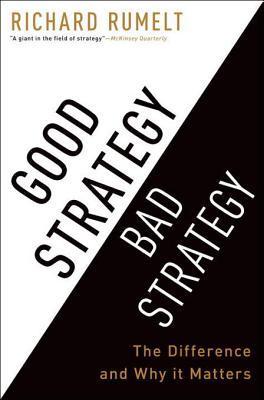
Key Insights & Memorable Quotes
The most popular highlights from Good Strategy Bad Strategy: The Difference and Why It Matters, saved by readers on Screvi.
The kernel of a strategy contains three elements: a diagnosis, a guiding policy, and coherent action.
Good strategy works by focusing energy and resources on one, or a very few, pivotal objectives whose accomplishment will lead to a cascade of favorable outcomes.
It is hard to show your skill as a sailor when there is no wind.
A leader’s most important job is creating and constantly adjusting this strategic bridge between goals and objectives.
A hallmark of true expertise and insight is making a complex subject understandable. A hallmark of mediocrity and bad strategy is unnecessary complexity—a flurry of fluff masking an absence of substance.
Mistaking goals for strategy. Many bad strategies are just statements of desire rather than plans for overcoming obstacles.
The first step of making strategy real is figuring out the big ‘aha’ to gain sustainable competitive advantage—in other words, a significant, meaningful insight about how to win.
A strategy coordinates action to address a specific challenge.
A strategy is like a lever that magnifies force.
Good strategy requires leaders who are willing and able to say no to a wide variety of actions and interests. Strategy is at least as much about what an organization does not do as it is about what it does.
Strategy is visible as coordinated action imposed on a system. When I say strategy is “imposed,” I mean just that. It is an exercise in centralized power, used to overcome the natural workings of a system. This coordination is unnatural in the sense that it would not occur
Bad strategy is long on goals and short on policy or action. It assumes that goals are all you need. It puts forward strategic objectives that are incoherent and, sometimes, totally impracticable. It uses high-sounding words and phrases to hide these failings.
The most basic idea of strategy is the application of strength against weakness. Or, if you prefer, strength applied to the most promising opportunity.
At the core, strategy is about focus, and most complex organizations don’t focus their resources. Instead, they pursue multiple goals at once, not concentrating enough resources to achieve a breakthrough in any of them.
A good strategy includes a set of coherent actions. They are not “implementation” details; they are the punch in the strategy. A strategy that fails to define a variety of plausible and feasible immediate actions is missing a critical component.
If you fail to identify and analyze the obstacles, you don’t have a strategy. Instead, you have either a stretch goal, a budget, or a list of things you wish would happen.
The discipline of analysis is to not stop there, but to test that first insight against the evidence.
the language of business strategy: identify your strengths and weaknesses, assess the opportunities and risks (your opponent’s strengths and weaknesses), and build on your strengths.
A good strategy honestly acknowledges the challenges being faced and provides an approach to overcoming them.
Given that background, I was interested in what Steve Jobs might say about the future of Apple. His survival strategy for Apple, for all its skill and drama, was not going to propel Apple into the future. At that moment in time, Apple had less than 4 percent of the personal computer market. The de facto standard was Windows-Intel and there seemed to be no way for Apple to do more than just hang on to a tiny niche. In the summer of 1998, I got an opportunity to talk with Jobs again. I said, “Steve, this turnaround at Apple has been impressive. But everything we know about the PC business says that Apple cannot really push beyond a small niche position. The network effects are just too strong to upset the Wintel standard. So what are you trying to do in the longer term? What is the strategy?” He did not attack my argument. He didn’t agree with it, either. He just smiled and said, “I am going to wait for the next big thing.
Unlike a stand-alone decision or a goal, a strategy is a coherent set of analyses, concepts, policies, arguments, and actions that respond to a high-stakes challenge.
Nevertheless, the doctrine that one can impose one’s visions and desires on the world by the force of thought alone retains a powerful appeal to many people. Its acceptance displaces critical thinking and good strategy.
Without constant attention, the design decays. Without active maintenance, the lines demarking products become blurred, and coherence is lost.
Strategies focus resources, energy, and attention on some objectives rather than others. Unless collective ruin is imminent, a change in strategy will make some people worse off. Hence, there will be powerful forces opposed to almost any change in strategy. This is the fate of many strategy initiatives in large organizations.
When someone says “Managers are decision makers,” they are not talking about master strategists, for a master strategist is a designer.
The core of strategy work is always the same: discovering the critical factors in a situation and designing a way of coordinating and focusing actions to deal with those factors.
A design-type strategy is an adroit configuration of resources and actions that yields an advantage in a challenging situation. Given a set bundle of resources, the greater the competitive challenge, the greater the need for the clever, tight integration of resources and actions. Given a set level of challenge, higher-quality resources lessen the need for the tight integration of resources and actions. These
It is often said that a strategy is a choice or a decision. The words “choice” and “decision” evoke an image of someone considering a list of alternatives and then selecting one of them. There is, in fact, a formal theory of decisions that specifies exactly how to make a choice by identifying alternative actions, valuing outcomes, and appraising probabilities of events. The problem with this view, and the reason it barely lightens a leader’s burden, is that you are rarely handed a clear set of alternatives. In the case at hand, Hannibal was certainly not briefed by a staff presenting four options arranged on a PowerPoint slide. Rather, he faced a challenge and he designed a novel response. Today, as then, many effective strategies are more designs than decisions—are more constructed than chosen. In these cases, doing strategy is more like designing a high-performance aircraft than deciding which forklift truck to buy or how large to build a new factory. When someone says “Managers are decision makers,” they are not talking about master strategists, for a master strategist is a designer.
Strategy does not eliminate scarcity and its consequence—the necessity of choice. Strategy is scarcity’s child and to have a strategy, rather than vague aspirations, is to choose one path and eschew others. There is difficult psychological, political, and organizational work in saying “no” to whole worlds of hopes, dreams, and aspirations.
Strategy is the craft of figuring out which purposes are both worth pursuing and capable of being accomplished.
Find Another Book
Search by title or author to explore highlights from other books.
More Books You Might Like
Explore highlights from similar books.


