Key Insights & Memorable Quotes
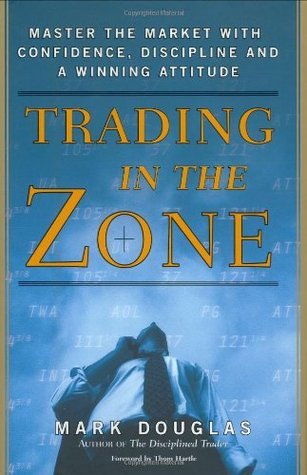
The most popular highlights from Trading in the Zone: Master the Market with Confidence, Discipline and a Winning Attitude, saved by readers on Screvi.
I AM A CONSISTENT WINNER BECAUSE: 1. I objectively identify my edges. 2. I predefine the risk of every trade. 3. I completely accept the risk or I am willing to let go of the trade. 4. I act on my edges without reservation or hesitation. 5. I pay myself as the market makes money available to me. 6. I continually monitor my susceptibility for making errors. 7. I understand the absolute necessity of these principles of consistent success and, therefore, I never violate them.
A probabilistic mind-set pertaining to trading consists of five fundamental truths. 1. Anything can happen. 2. You don’t need to know what is going to happen next in order to make money. 3. There is a random distribution between wins and losses for any given set of variables that define an edge. 4. An edge is nothing more than an indication of a higher probability of one thing happening over another. 5. Every moment in the market is unique.
Most traders have absolutely no concept of what it means to be a risk-taker in the way a successful trader thinks about risk. The best traders not only take the risk, they have also learned to accept and embrace that risk. There is a huge psychological gap between assuming you are a risk-taker because you put on trades and fully accepting the risks inherent in each trade. When you fully accept the risks, it will have profound implications on your bottom-line performance.
The hard, cold reality of trading is that every trade has an uncertain outcome.
a greater probability of one thing happening over another. In a sense, technical analysis allows you
the typical trader wants to be right on every single trade. He is desperately
When you learn the trading skill of risk acceptance, the market will not be able to generate information that you define or interpret as painful. If the information the market generates doesn’t have the potential to cause you emotional pain, there’s nothing to avoid. It is just information, telling you what the possibilities are. This is called an objective perspective—one that is not skewed or distorted by what you are afraid is going to happen or not happen.
Learning to accept the risk is a trading skill—the most important skill you can learn.
Remember our definition of a winning attitude: a positive expectation of your efforts with an acceptance that whatever results you get are a perfect reflection of your level of development and what you need to learn to do better.
We have to be careful about what we project out into the future, because nothing else has the potential to create more unhappiness and emotional misery than an unfulfilled expectation.
All of us are born into some sort of social environment. A social environment (or society), whether its a family, city, state, or country, implies the existence of structure. Social structures consist of rules, restrictions, boundaries, and a set of beliefs that become a code of behavior that limits the ways in which individuals within that social structure can or cannot express themselves. Furthermore, most of the limitations of social structure were established before we are born. In other words, by the time any of us get here, most of the social structure governing our individual expression is in place and well entrenched.
Unless you learn to completely accept the possibility of an uncertain outcome, you will try either consciously or unconsciously to avoid any possibility you define as painful.
When you learn the trading skill of risk acceptance, the market will not be able to generate information that you define or interpret as painful.
This lack of support is not simply an absence of encouragement. It can be as deep as the outright denial of some particular way in which we want to express ourselves.
However, market analysis is not the path to consistent results. It will not solve the trading problems created by lack of confidence, lack of discipline, or improper focus.
The best traders aren’t afraid. They aren’t afraid because they have developed attitudes that give them the greatest degree of mental flexibility to flow in and out of trades based on what the market is telling them about the possibilities from its perspective. At the same time, the best traders have developed attitudes that prevent them from getting reckless.
Taking responsibility means acknowledging and accepting, at the deepest part of your identity, that you—not the market—are completely responsible for your success or failure as a trader.
The winners have attained a mind-set—a unique set of attitudes—that allows them to remain disciplined, focused, and, above all, confident in spite of the adverse conditions. As a result, they are no longer susceptible to the common fears and trading errors that plague everyone else.
1. Anything can happen. 2. You don’t need to know what is going to happen next in order to make money. 3. There is a random distribution between wins and losses for any given set of variables that define an edge. 4. An edge is nothing more than an indication of a higher probability of one thing happening over another. 5. Every moment in the market is unique.
1. I objectively identify my edges. 2. I predefine the risk of every trade. 3. I completely accept the risk or I am willing to let go of the trade. 4. I act on my edges without reservation or hesitation. 5. I pay myself as the market makes money available to me. 6. I continually monitor my susceptibility for making errors.
The fact is that if traders really believed that anything could happen at any time, there would be considerably fewer losers and more consistent winners.
Everyone who trades ends up learning something about the markets; very few people who trade ever learn the attitudes that are absolutely essential to becoming a consistent winner.
When you genuinely accept the risks, you will be at peace with any outcome. When you’re at peace with any outcome, you will experience a carefree, objective state of mind, where you make yourself available to perceive and act upon whatever the market is offering you (from its perspective) at any given “now moment.
I define random trading as poorly-planned trades or trades that are not planned at all. It is an unorganized approach that takes into consideration an unlimited set of market variables, which do not allow you to find out what works on a consistent basis and what does not.
So if you are afraid of being wrong or losing money, it means you will never learn enough to compensate for the negative effects these fears will have on your ability to be objective and your ability to act without hesitation.
They create our expectations. Keep in mind that an expectation is a belief projected into some future moment. Since we can’t expect something we don’t know about, we could also say that an expectation is what we know projected into some future moment.
When you operate from the assumption that more or better analysis will create consistency, you will be driven to gather as many market variables as possible into your arsenal of trading tools. But what happens then? You are still disappointed and betrayed by the markets, time and again, because of something you didn’t see or give enough consideration to. It will feel like you can’t trust the markets; but the reality is, you can’t trust yourself.
you asked me to distill trading down to its simplest form, I would say that it is a pattern recognition numbers game.
They manage our perception and interpretation of environmental information in a way that is consistent with what we believe.
How do we remain disciplined, focused, and confident in the face of constant uncertainty?
Find Another Book
Search by title or author to explore highlights from other books.
More Books You Might Like
Explore highlights from similar books.