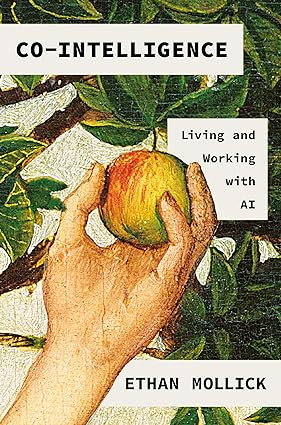
Key Insights & Memorable Quotes
The most popular highlights from Co-Intelligence: Living and Working with AI, saved by readers on Screvi.
As artificial intelligence proliferates, users who intimately understand the nuances, limitations, and abilities of AI tools are uniquely positioned to unlock AI’s full innovative potential. These user innovators are often the source of breakthrough ideas for new products and services.
You should try inviting AI to help you in everything you do, barring legal or ethical barriers. As you experiment, you may find that AI help can be satisfying, or frustrating, or useless, or unnerving. But you aren’t just doing this for help alone; familiarizing yourself with AI’s capabilities allows you to better understand how it can assist you—or threaten you and your job.
We have invented technologies, from axes to helicopters, that boost our physical capabilities; and others, like spreadsheets, that automate complex tasks; but we have never built a generally applicable technology that can boost our intelligence.
One small study of undergraduates found that 66 percent of men and 25 percent of women choose to painfully shock themselves rather than sit quietly with nothing to do for 15 minutes. Boredom doesn’t just lead us to hurt ourselves; 18 percent of bored people killed worms when given a chance (only 2 percent of non-bored people did). Bored parents and soldiers both act more sadistically. Boredom is not just boring; it is dangerous in its own way.
At the core of the most extreme dangers from AI is the stark fact that there is no particular reason that AI should share our view of ethics and morality.
This book may seem as if it is full of science fiction, but everything I am describing has already happened. We have created a weird alien mind, one that isn’t sentient but can fake it remarkably well. It is trained on the vast archives of human knowledge, and also on the backs of low-paid workers. It can pass tests and act creatively, with the potential to change how we work and learn; but it also makes up information regularly. You can no longer trust that anything you see, or hear, or read was not created by AI. All of that already happened. Humans, walking and talking bags of water and trace chemicals that we are, have managed to convince well-organized sand to pretend to think like us.
The complication is that AI does not really plagiarize, in the way that someone copying an image or a block of text and passing it off as their own is plagiarizing. The AI stores only the weights from its pretraining, not the underlying text it trained on, so it reproduces a work with similar characteristics but not a direct copy of the original pieces it trained on. It is, effectively, creating something new, even if it is a homage to the original. However, the more often a work appears in the training data, the more closely the underlying weights will allow the AI to reproduce the work. For books that are repeated often in the training data-like Alice's Adventures in Wonderland-the AI can nearly reproduce it word for word. Similarly, art Als are often trained on the most common images on the internet, so they produce good wedding photographs and pictures of celebrities as a result.
And you can’t figure out why an AI is generating a hallucination by asking it. It is not conscious of its own processes. So if you ask it to explain itself, the AI will appear to give you the right answer, but it will have nothing to do with the process that generated the original result. The system has no way of explaining its decisions, or even knowing what those decisions were. Instead, it is (you guessed it) merely generating text that it thinks will make you happy in response to your query. LLMs are not generally optimized to say “I don’t know” when they don’t have enough information. Instead, they will give you an answer, expressing confidence.
Traditional software is predictable, reliable, and follows a strict set of rules. When properly built and debugged, software yields the same outcomes every time. AI, on the other hand, is anything but predictable and reliable. It can surprise us with novel solutions, forget its own abilities, and hallucinate incorrect answers. This unpredictability and unreliability can result in a fascinating array of interactions. I have been startled by the creative solutions AI develops in response to a thorny problem, only to be stymied as the AI completely refuses to address the same issue when I ask again.
Mitigating the risk of extinction from AI should be a global priority alongside other societal-scale risks such as pandemics and nuclear war.
An AI future requires that we lean into building our own expertise as human experts. Since expertise requires facts, students will still need to learn reading, writing, history, and all the other basic skills required in the twenty-first century. We have already seen how this broad-based knowledge can help people get the most out of AI. And besides, we need to continue to have educated citizens rather than delegate all our thinking to machines.
We count on most terrorists and criminals to be relatively dumb, but AI may prove to boost their capabilities in dangerous ways.
This tends to make us uncomfortable: After all, how can AI, a machine, generate something new and creative? The issue is that we often mistake novelty for originality. New ideas do not come from the ether; they are based on existing concepts. Innovation scholars have long pointed to the importance of recombination in generating ideas. Breakthroughs often happen when people connect distant, seemingly unrelated ideas. To take a canonical example, the Wright brothers combined their experience as bicycle mechanics and their observations of the flight of birds to develop their concept of a controllable plane that could be balanced and steered by warping its wings.
Raj, conversely, integrates an AI-driven architectural design assistant into his workflow. Each time he creates a design, the AI provides instantaneous feedback. It can highlight structural inefficiencies, suggest improvements based on sustainable materials, and even predict potential costs. Moreover, the AI offers comparisons between Raj’s designs and a vast database of other innovative architectural works, highlighting differences and suggesting areas of improvement. Instead of just iterating designs, Raj engages in a structured reflection after every project, thanks to the insights from the AI. It’s akin to having a mentor watching over his shoulder at every step, nudging him toward excellence.
But in many ways, hallucinations are a deep part of how LLMs work. They don’t store text directly; rather, they store patterns about which tokens are more likely to follow others. That means the AI doesn’t actually “know” anything. It makes up its answers on the fly. Plus, if it sticks too closely to the patterns in its training data, the model is said to be overfitted to that training data. Overfitted LLMs may fail to generalize to new or unseen inputs and generate irrelevant or inconsistent text—in short, their results are always similar and uninspired. To avoid this, most AIs add extra randomness in their answers, which correspondingly raises the likelihood of hallucination.
Los consumidores también los han adoptado muy rápido: ChatGPT alcanzó los cien millones de usuarios más deprisa que cualquier otro producto en la historia, impulsado por varios factores: era de acceso gratuito, se puso a disposición de los consumidores individuales y resultaba increíblemente útil.[
Each study has concluded the same thing: almost all of our jobs will overlap with the capabilities of AI. As I’ve alluded to previously, the shape of this AI revolution in the workplace looks very different from every previous automation revolution, which typically started with the most repetitive and dangerous jobs. Research by economists Ed Felten, Manav Raj, and Rob Seamans concluded that AI overlaps most with the most highly compensated, highly creative, and highly educated work. College professors make up most of the top 20 jobs that overlap with AI (business school professor is number 22 on the list ). But the job with the highest overlap is actually telemarketer. Robocalls are going to be a lot more convincing, and a lot less robotic, soon. Only 36 job categories out of 1,016 had no overlap with AI. Those few jobs included dancers and athletes, as well as pile driver operators, roofers, and motorcycle mechanics (though I spoke to a roofer, and they were planning on using AI to help with marketing and customer service, so maybe 35 jobs). You will notice that these are highly physical jobs, ones in which the ability to move in space is critical. It highlights the fact that AI, for now at least, is disembodied. The boom in artificial intelligence is happening much faster than the evolution of practical robots, but that may change soon. Many researchers are trying to solve long-standing problems in robotics with Large Language Models, and there are some early signs that this might work, as LLMs make it easier to program robots that can really learn from the world around them.
In the short term, then, we might expect to see little change in employment (but many changes in tasks), but, as Amara’s Law, named after futurist Roy Amara, says: “We tend to overestimate the effect of a technology in the short run and underestimate the effect in the long run.
the most innovative people benefit the least7 from AI creative help.
The fact that it is time consuming is somewhat the point. That a professor takes the time to write a good letter is a sign that they support the student's application. We are setting our time on fire to signal to others that this letter is worth reading.
LLMs are connection machines. They are trained by generating relationships between tokens that may seem unrelated to humans but represent some deeper meaning. Add in the randomness that comes with AI output, and you have a powerful tool for innovation. The AI seeks to generate the next word in a sequence by finding the next likely token, no matter how weird the previous words were. So it should be no surprise that the AI can come up with novel concepts with ease. I asked AI to: Find me business ideas that would incorporate fast food, patent 6,604,835 B2 [which turned out to be for a lava lamp that included bits of crystal], and 14th century England.
To make the most of this relationship, you must establish a clear and specific AI persona, defining who the AI is and what problems it should tackle.
The most common approach to reducing bias is for humans to correct the AIs, as in the Reinforcement Learning from Human Feedback (RLHF) process, which is part of the fine-tuning of LLMs that we discussed in the previous chapter.
AI is what those of us who study technology call a General Purpose Technology (ironically, also abbreviated GPT). These advances are once-in-a-generation technologies, like steam power or the internet, that touch every industry and every aspect of life. And, in some ways, generative AI might even be bigger.
a judge, the AI generates a picture of a man 97 percent of the time, even though 34 percent of US judges are women. In showing fast-food workers, 70 percent had darker skin tones, even though 70 percent of American fast-food workers are white.
The issue is that in order to learn to think critically, problem-solve, understand abstract concepts, reason through novel problems, and evaluate the AI’s output, we need subject matter expertise.
that severely curtailed their usefulness. The Transformer solved these issues by utilizing an “attention mechanism.” This technique allows the AI to concentrate on the most relevant parts of a text, making it easier for the AI to understand and work with language in a way that seemed more human.
With lower-cost workers doing the same work in less time, mass unemployment, or at least underemployment, becomes more likely, and we may see the need for policy solutions, like a four-day workweek or universal basic income, that reduce the floor for human welfare.
Current systems are not good enough in their understanding of context, nuance, and planning. That is likely to change.
The gap between the programmers in the top 75th percentile and those in the bottom 25th percentile can be as much as 27 times along some dimensions of programming quality.
Find Another Book
Search by title or author to explore highlights from other books.
More Books You Might Like
Explore highlights from similar books.