Key Insights & Memorable Quotes
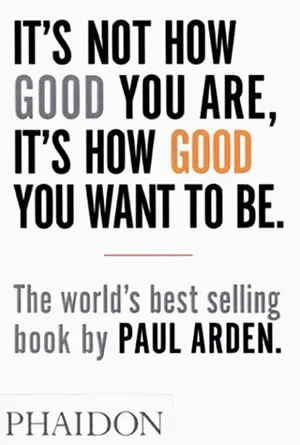
The most popular highlights from It's Not How Good You Are, It's How Good You Want To Be, saved by readers on Screvi.
“Being right is based upon knowledge and experience and is often provable. Knowledge comes from the past, so it's safe. It is also out of date. It's the opposite of originality. Experience is built from solutions to old situations and problems. The old situations are probably different from the present ones, so that old solutions will have to be bent to fit new problems (and possibly fit badly). Also the likelihood is that, if you've got the experience, you'll probably use it. This is lazy. Experience is the opposite of being creative. If you can prove you're right you're set in concrete. You cannot move with the times or with other people. Being right is also being boring. Your mind is closed. You are not open to new ideas. You are rooted in your own rightness, which is arrogant. Arrogance is a valuable tool, but only if used very sparingly. Worst of all, being right has a tone of morality about it. To be anything else sounds weak or fallible, and people who are right would hate to be thought fallible. So: it's wrong to be right, because people who are right are rooted in the past, rigid-minded, dull and smug. There's no talking to them.”
“If you can't solve a problem, it's because you're playing by the rules”
“Risks are a measure of people. People who won't take them are trying to preserve what they have. People who do take them often end up having more.Some risks have a future, and some people call them wrong. But being right may be like walking backwards proving where you've been.Being wrong isn't in the future, or in the past.Being wrong isn't anywhere but being here.Best place to be, eh?”
“Your vision of where or who you want to be is the greatest asset you have. Without having a goal it’s difficult to score.”
“Be unfashionable. Take risks.”
“Don't be afraid of silly ideas.”
“How you perceive yourself is how others will see you.”
“Don't look for the next opportunity. The one you have in hand is the opportunity.”
“Have you noticed how the cleverest people at school are not those who make it in life?People who are conventionally clever get jobs on their qualifications (the past), not on their desire to succeed (the future).Very simply, they get overtaken by those who continually strive to be better than they are.”
“High creativity is responding to situations without critical thought.' - John Cleese”
“Change your tools, it may free your thinking.”
“The more strikingly visual your presentation is, the more people will remember it.”
“The perosn who doesn't make mistakes is unlikely to make anything.”
“To be original, seek your inspiration from unexpected sources.”
“If, instead of seeking approval, you ask, 'What's wrong with it? How can I make it better?', you are more likely to get a truthful, critical answer.”
“Failure was a major contributor to its success.”
“It's not how good you are, it's how good you want to be.”
“If you think you're unable to be on the cover of Time magazine, make it your business to be there.”
“You need to aim beyond what you are capable of.”
“Do not covet your ideas. Give away everything you know and more will come back to you.”
“Experience is the opposite of being creative.”
“Nearly all rich an powerful people are not notably talented, educated, charming or good-looking. They become rich and powerful by wanting to be rich and powerful.”
“If you think you're unable to be on the cover of Time magazine, make your business to be there.”
“Successful solutions are often made by people rebelling against bad briefs.”
“The point is we are all selling. We are all in advertising. It is part of life.”
“Talent helps, but it won't take you as far as ambition.”
“Be true to your subject and you will be far more likely to create something that is timeless.”
“All creative people need something to rebel against, it's what gives their lives excitement, and it's creative people who make the clients' lives exciting.”
“The point is that, whatever other people's failings might be, you are the one to shoulder the responsibility.”
“It's not how good you are, It's how good you want to be.”
Find Another Book
Search by title or author to explore highlights from other books.
More Books You Might Like
Explore highlights from similar books.


