Key Insights & Memorable Quotes
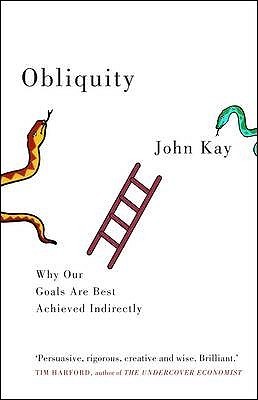
The most popular highlights from Obliquity: Why Our Goals Are Best Achieved Indirectly, saved by readers on Screvi.
Through experiences we normally associate with unhappiness they achieve greater happiness than if they had sought happiness directly.
No one will be buried with the epitaph ‘He maximised shareholder value
I am not saying that personal development is more important than winning; on the contrary, I am saying that enjoying the journey of self-discovery, by removing some of the pressure and angst associated with winning at all costs, is one way of helping you to win more often.
… the problem, and our understanding of it, changes as we tackle it.
There is a role for carrots and sticks, but to rely on carrots and sticks alone is effective only when we employ donkeys and we are sure exactly what we want the donkeys to do.
The computer is very good at solving the problem we have specified and asked it to solve, but less useful when we are not quite sure what the problem is.
Effective decision makers are distinguished not so much by the superior extent of their knowledge as by their being aware of its limitations.
Art,” said Picasso, “is a lie that makes us realize the truth.
Success depends on the flair, skills and initiative of people who cannot be effectively supervised.
We don’t consider any man successful until he has died well.
If we sometimes recast problems before we begin, more often we revise our specification in the process of actually tackling them.
The criteria that determine artistic success are ultimately determined by artists, not critics, and great art itself changes what these criteria are.
The job of the artist or the poet or the educator or the business person is not just to paint what we want to see, write what we want to read and hear, teach us what we want to learn or produce what we want to buy. Their role is to interpret the underlying high-level objectives that we seek from art, poetry, education, or goods and services more fully than we could ourselves articulate them. Success in recasting problems to achieve our objectives more effectively than we had conceived distinguishes the great from the merely competent ad demonstrates why the direct approach is so often banal.
We incline to see history through the lives of great men. That inclination blinds us to the real complexity …
Find Another Book
Search by title or author to explore highlights from other books.
More Books You Might Like
Explore highlights from similar books.