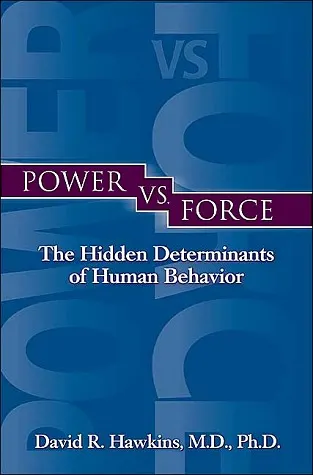
Key Insights & Memorable Quotes
The most popular highlights from Power vs. Force: The Hidden Determinants of Human Behavior, saved by readers on Screvi.
“Force can bring satisfaction, but only power brings joy. Victory over others brings us satisfaction, but victory over ourselves brings us joy.”
“Eventually, it can lead us to have compassion for everyone, when we see how we all must struggle with the downside of human nature. Everyone is crippled in some area, and everyone is somewhere on the path of evolution, some ahead of us, and some behind.”
“With Acceptance, there is emotional calm and perception is widened as denial is transcended.”
“Reason deals only with particulars, whereas Love deals with wholes.”
“The skillful are not obviousThey appear to be simple-mindedThose who know this know the patternsof the AbsoluteTo know the patterns is the Subtle PowerThe Subtle Power moves all things andhas no name.”
“love is more powerful than hatred; truth sets us free; forgiveness liberates both sides; unconditional love heals; courage empowers; and the essence of Divinity/Reality is peace.”
“La compasión es uno de los patrones atractores más elevados. Como veremos, la capacidad de entender, perdonar y aceptar se vincula de forma directa con la salud personal.”
“vitamin therapy, only 37, rather than the predicted nearly 20,000, developed the disorder.)4 The paper was largely ignored in the”
“on long-term treatment with major anti-psychotics.”
“The truth of one’s Self can be discovered in everyday life. To live with care and kindness is all that is necessary. The rest reveals itself in due time.”
“The permanent high-state experience, which may be legitimately attained only through a lifetime of dedicated inner work, can be reached temporarily by artificial means. But the balance of nature dictates that to artificially acquire that state without having earned it creates a debt, and the negative imbalance results in negative consequences. The cost of such stolen pleasure is the desperation of addiction, and finally, both the addict and society pay a price.”
“The higher the level of these states, the greater its power to reprogram the subject’s entire life. Not uncommonly, just one instant in a very high state can completely change a person’s orientation to life, as well as his goals and values. It can be said that the individual who was, is no more, and a new person is born out of the experience. Through hard-won progress on a dedicated spiritual path, this is the very mechanism of spiritual evolution.”
“is motivation. Motivation proceeds from meaning, and meaning, in turn, is an expression of context. Thus, achievement is bounded by context, which, when correspondingly aligned with motivation, determines the individual’s relative power.”
“Characteristic of this energy field is the capacity for enormous patience and the persistence of a positive attitude in the face of prolonged adversity. The hallmark of this state is compassion. People who have attained this level have a notable effect on others. They are capable of a prolonged, open visual gaze, which induces a state of love and peace.”
“Joy arises from within each moment of existence, rather than from any external source.”
“Love is therefore inclusive and expands the sense of self progressively. Love focuses on the goodness of life in all its expressions and augments that which is positive. It dissolves negativity by recontextualizing it rather than by attacking it.”
“Despite our mistrust of simplification, we may see two general classes of people in the world: believers and nonbelievers. To the nonbelievers, everything is false until proven true; to the believers, everything said in good faith is probably true unless it is proven false.”
“Despite our mistrust of simplification, we may see two general classes of people in the world: believers and nonbelievers. To the nonebelievers, everything is false until proven true; to the believers, everything said in good faith is probably true unless it is proven false.”
“Because this subject matter is, in fact, extraordinarily simple, it is difficult to present in a world enamored of complexity.”
“Love that is unconditional, unchanging, and permanent. It does not fluctuate because its source within the person who loves is not dependent on external conditions. Loving is a state of being. It is a way of relating to the world that is forgiving, nurturing, and supportive. Love is not intellectual and does not proceed from the mind. Love emanates from the heart. It has the capacity to lift others and accomplish great feats because of its purity of motive.”
“The key to Joy is unconditional kindness to all of life, including one’s own, which we refer to as compassion.1 Without compassion, little of any significance is ever accomplished in human endeavor. We may generalize to the greater social context from individual therapies, wherein patients cannot be truly cured or fundamentally healed until they invoke the power of compassion, both for themselves and others. At that point, the healed may become a healer.”
“Contemplation of the Map of Consciousness can, for instance, transform one’s understanding of causality. As perception itself evolves with one’s level of consciousness, becomes apparent that what the world calls the domain of causes is in fact the domain of effects. By taking responsibility for the consequences of their own perceptions, observers can transcend the role of victim to an understanding that “nothing out there has power over you.” It is not life’s events, but how one reacts to them and the attitude that one has about them, which determine whether the events have a positive or negative effect on one’s life, whether they are experienced as opportunity or as stress.”
“Todo el mundo muere por su propia mano: esto es un dato clínico puro y duro, no una posición moral.”
“Las pruebas quinesiológicas mostraron que un programa de televisión típico debilitó a los sujetos ciento trece veces durante un solo episodio. Cada uno de estos sucesos debilitantes suprime el sistema inmunitario del observador y agrede sus sistemas nerviosos central y autónomo.”
“Las enseñanzas de Abraham calibraban en 985;”
“el budismo hinayana («pequeño vehículo») aún calibra en 890; el budismo mahayana («gran vehículo») calibra en 960; el budismo zen, en 890.”
“La cábala, en 720; y el Zohar, en 730.”
“versión Rey Jaime (traducida del griego) calibra en 640.”
“la verdad es cualquier cosa que resulte subjetivamente convincente en el actual nivel de percepción de una persona.”
“La malicia enferma, literalmente; siempre se es víctima de las propias ansias de venganza. Incluso los pensamientos hostiles que se mantienen en secreto dan como resultado un ataque fisiológico contra el propio cuerpo.”
Find Another Book
Search by title or author to explore highlights from other books.
More Books You Might Like
Explore highlights from similar books.


