Key Insights & Memorable Quotes
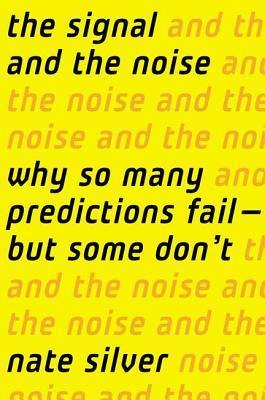
The most popular highlights from The Signal and the Noise: Why So Many Predictions Fail—But Some Don't, saved by readers on Screvi.
Distinguishing the signal from the noise requires both scientific knowledge and self-knowledge: the serenity to accept the things we cannot predict, the courage to predict the things we can, and the wisdom to know the difference.
The signal is the truth. The noise is what distracts us from the truth.
Most of you will have heard the maxim "correlation does not imply causation." Just because two variables have a statistical relationship with each other does not mean that one is responsible for the other. For instance, ice cream sales and forest fires are correlated because both occur more often in the summer heat. But there is no causation; you don't light a patch of the Montana brush on fire when you buy a pint of Haagan-Dazs.
The irony is that by being less focused on your results, you may achieve better ones.
We need to stop, and admit it: we have a prediction problem. We love to predict things—and we aren’t very good at it.
One of the pervasive risks that we face in the information age, as I wrote in the introduction, is that even if the amount of knowledge in the world is increasing, the gap between what we know and what we think we know may be widening.
Good innovators typically think very big and they think very small. New ideas are sometimes found in the most granular details of a problem where few others bother to look. And they are sometimes found when you are doing your most abstract and philosophical thinking, considering why the world is the way that it is and whether there might be an alternative to the dominant paradigm. Rarely can they be found in the temperate latitudes between they two spaces, where we spend 99 percent of our lives.
As the statistician George E. P. Box wrote, "All models are wrong, but some models are useful." What he meant by that is that all models are simplifications of the universe, as they must necessarily be. As another mathematician said, "The best model of a cat is a cat."...The key is in remembering that a model is a tool to help us understand the complexities of the universe, and never a substitute for the universe itself.
Data Is Useless Without Context
If political scientists couldn’t predict the downfall of the Soviet Union—perhaps the most important event in the latter half of the twentieth century—then what exactly were they good for?
Shakespeare's plays often turn on the idea of fate, as much drama does. What makes them so tragic is the gap between what his characters might like to accomplish and what fate provides them.
Wherever there is human judgment there is the potential for bias.
But forecasters often resist considering these out-of-sample problems. When we expand our sample to include events further apart from us in time and space, it often means that we will encounter cases in which the relationships we are studying did not hold up as well as we are accustomed to. The model will seem to be less powerful. It will look less impressive in a PowerPoint presentation (or a journal article or a blog post). We will be forced to acknowledge that we know less about the world than we thought we did. Our personal and professional incentives almost always discourage us from doing this.
The story the data tells us is often the one we’d like to hear, and we usually make sure that it has a happy ending.
When catastrophe strikes, we look for a signal in the noise - anything that might explain the chaos that we see all around us and bring order to the world again.
The more interviews that an expert had done with the press, Tetlock found, the worse his predictions tended to be.
We face danger whenever information growth outpaces our understanding of how to process it. The last forty years of human history imply that it can still take a long time to translate information into useful knowledge, and that if we are not careful, we may take a step back in the meantime.
Economy is not baseball, where the game is always played by the same rules.
Finding patterns is easy in any kind of data-rich environment; that’s what mediocre gamblers do. The key is in determining whether the patterns represent noise or signal.
Johannes Gutenberg’s invention in 1440 made information available to the masses, and the explosion of ideas it produced had unintended consequences and unpredictable effects. It was a spark for the Industrial Revolution in 1775,1 a tipping point in which civilization suddenly went from having made almost no scientific or economic progress for most of its existence to the exponential rates of growth and change that are familiar to us today. It set in motion the events that would produce the European Enlightenment and the founding of the American Republic. But the printing press would first produce something else: hundreds of years of holy war. As mankind came to believe it could predict its fate and choose its destiny, the bloodiest epoch in human history followed.2
Risk, as first articulated by the economist Frank H. Knight in 1921,45 is something that you can put a price on. Say that you’ll win a poker hand unless your opponent draws to an inside straight: the chances of that happening are exactly 1 chance in 11.46 This is risk. It is not pleasant when you take a “bad beat” in poker, but at least you know the odds of it and can account for it ahead of time. In the long run, you’ll make a profit from your opponents making desperate draws with insufficient odds. Uncertainty, on the other hand, is risk that is hard to measure. You might have some vague awareness of the demons lurking out there. You might even be acutely concerned about them. But you have no real idea how many of them there are or when they might strike. Your back-of-the-envelope estimate might be off by a factor of 100 or by a factor of 1,000; there is no good way to know. This is uncertainty. Risk greases the wheels of a free-market economy; uncertainty grinds them to a halt.
Who needs theory when you have so much information? But this is categorically the wrong attitude to take toward forecasting, especially in a field like economics where the data is so noisy.
The most calamitous failures of prediction usually have a lot in common. We focus on those signals that tell a story about the world as we would like it to be, not how it really is. We ignore the risks that are hardest to measure, even when they pose the greatest threats to our well-being. We make approximations and assumptions about the world that are much cruder than we realize. We abhor uncertainty, even when it is an irreducible part of the problem we are trying to solve.
Meanwhile, exposure to so many new ideas was producing mass confusion. The amount of information was increasing much more rapidly than our understanding of what to do with it, or our ability to differentiate the useful information from the mistruths. Paradoxically, the result of having so much more shared knowledge was increasing isolation along national and religious lines. The instinctual shortcut that we take when we have “too muchinformation” is to engage with it selectively, picking out the parts we like and ignoring theremainder, making allies with those who have made the same choices and enemies ofthe rest.
What makes him successful is the way that he analyzes information. He is not just hunting for patterns. Instead, Bob combines his knowledge of statistics with his knowledge of basketball in order to identify meaningful relationships in the data.
The alchemy that the ratings agencies performed was to spin uncertainty into what looked and felt like risk. They took highly novel securities, subject to an enormous amount of systemic uncertainty, and claimed the ability to quantify just how risky they were. Not only that, but of all possible conclusions, they came to the astounding one that these investments were almost risk-free.
A forecaster should almost never ignore data, especially when she is studying rare events like recessions or presidential elections, about which there isn’t very much data to begin with. Ignoring data is often a tip-off that the forecaster is overconfident, or is overfitting her model—that she is interested in showing off rather than trying to be accurate.
Making predictions based on our beliefs is the best (and perhaps even the only) way to test ourselves. If objectivity is the concern for a greater truth beyond our personal circumstances, and prediction is the best way to examine how closely aligned our personal perceptions are with that greater truth, the most objective among us are those who make the most accurate predictions.
When we advance more confident claims and they fail to come to fruition, this constitutes much more powerful evidence against our hypothesis. We can't really blame anyone for losing faith when this occurs
When they play against each other, the game usually comes down to who can find his opponent’s blind spots first.
Find Another Book
Search by title or author to explore highlights from other books.
More Books You Might Like
Explore highlights from similar books.