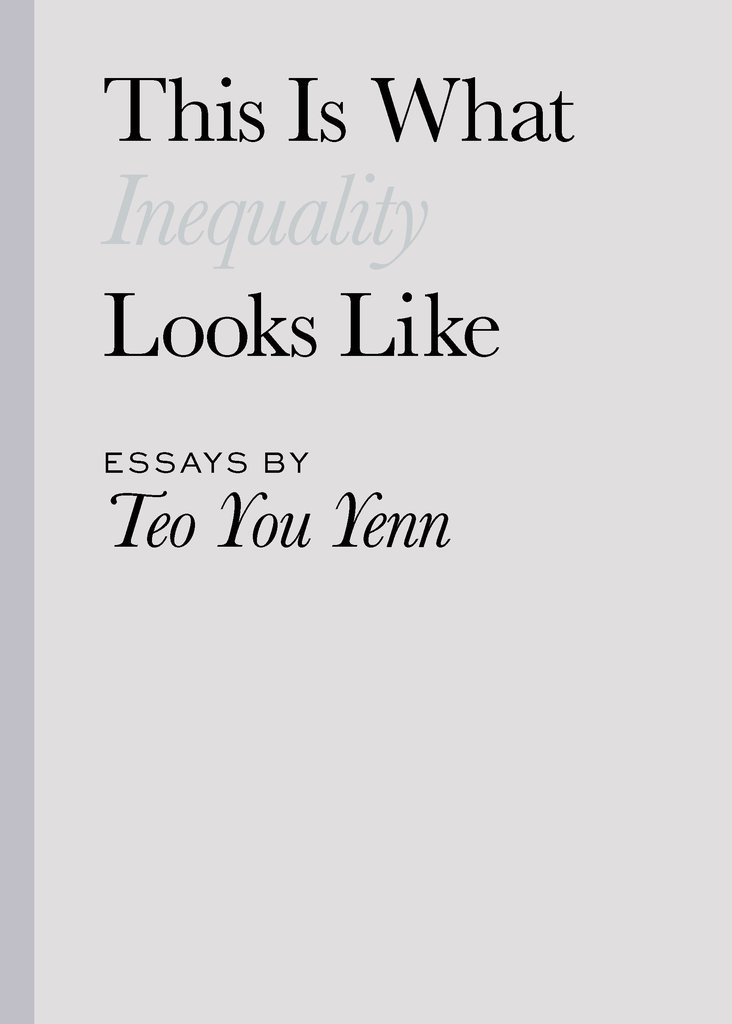
Key Insights & Memorable Quotes
The most popular highlights from This Is What Inequality Looks Like, saved by readers on Screvi.
Inequality, in fact, is a logical outcome of meritocracy. What the education system does when it selects, sorts, and hierarchizes, and when it gives its stamp of approval to those 'at the top,' is that it renders those who succeed through the system as legitimately deserving. Left implicit is that those at the bottom have failed to be deserving.
low-income parents find themselves having to do this immensely difficult thing: they have to tell hteir kids to listen to them and yet also send them the message “don’t be like me.” It is difficult to exercise authority under these conditions. To have one’s parenting practices be unintelligible, unacknowledged, deemed less worthy, is a profound form of attack on the self, especially when being a parent is a central part of one’s identity.
The respect I am accorded are conditional on my participation in society as an economically productive and relatively wealthy person. It has little to do with my inherent right to respect as a human being and member of this society.
We who have the power to make choices disproportionately shape outcomes and limit options for people who don’t have the power to make choices. It follows that if we don’t share the power to make choices, we will never see a change to those things we say are bad or unacceptable to our society. When those of us who have the means maximize our own children’s and our own families’ advantages, we are contributing to strengthening norms about achievement, success/failure, that undermine our fellow citizens’ well-being.
Low-income parents do not necessarily make more ‘bad choices’ than parents with higher income, but more of their practices turn out to have negative outcomes. It is more accurate to say that they have bad options for managing the need for money and the need of their kids for care
Our national discourse emphasizes sacrifice, community, greater good. Our institutions, our everyday lives—they regulate and compel individualism, competition, self-centeredness.
In sociological literature, meritocracy is widely recognized as a system for sorting, selecting, and then differentially rewarding people; it is a system for legitimizing the process and outcomes of sorting, based on narrow notions of what is worth rewarding and what is not. And it works well when there is, what Pierre Bourdieu referred to as “misrecognition.” Misrecognition happens when we think that a system is based on a certain set of principles when it really works on the basis of another, when we think it rewards each individual’s hard work when in reality it rewards economic and cultural capital passed on from parents to children.
They allow us to feel like we belong to the groups we care about, that we are rooted in, and that we need respect, acceptance and love from. As the title of (Allison) Pugh’s book suggests – we long for things because we long to belong.
We make meaning through our everyday lives--in small activities and through relationships. These are moments of potential beauty. They are the acts that make us human. The inclination by class-privileged women and men to reject the domestic realm because we see and know that it is the sphere of less power--it is an inclination that gives up too much and we must claw it back. In the process, we must also work to expand the space for everyone to meet their needs--make real choices, partake in the mundane, live lives, be human. To do this, we need reasonable employment conditions across the class spectrum and social policies that are not class-biased but genuinely supportive of all families. No one should have to be super in order to be human.
There is insufficient attention to the fact that reward and punishment systems are not neutral. Not all qualities, skills, and capacities are equally valued in our society. Inadequate thought is given to the ways in which some of us set the standards against which others are measured.
It is disingenuous to claim that all tracks are good and all paths valued; if this were the case, and if Singaporeans actually believe this, tuition centers would be out of business.
for higher-class parents, children are ‘projects.’ They have tightly scheduled lives and coordinated activities; high-income parents spend significant time and energy thinking about how to fulfill their kids’ ‘potentials.’ For the working class and poor, Lareau argues, parenting is more about ‘the accomplishment of natural growth.’ Top priorities in these families are safety and health.
We make meaning through our everyday lives - in small activities and through relationships. These are moments of potential beauty. They are the acts that make us human.
What we do and do not do are shaped by our sense of how others are — shared understandings of right and wrong, good and bad, valuable and worthless. The pathways and practices we end up taking are rendered meaningful by shared scripts and narratives that permeate our society.
Mobility and immobility are at once spatial and temporal—they are about movement through places and also changes over time.
power is not a frame of mind but a material condition. People sitting in positions of authority are powerful not because they feel empowered but because they have power.
Parenting is not merely about keeping children alive. While children above a certain age no longer need constant supervision, family relationships make a big difference to parents’ and children’s well-being.
By virtue of rewarding precocity—expecting kids to be able to read and write when they begin Primary 1, for example— the school system values its role in sorting ahead of its role in teaching.
The sociologist Pierre Bourdieu spoke of parents from higher class backgrounds subtly transmitting advantages to their children—through socializing them in ways of speaking, relating to authority figures, and understanding things like art and music.19 He called these “cultural capital”—they are qualities that schools reward and yet do not teach. They are ‘capital’ because they eventually translate into formal credentials and, importantly, into legitimate status.
We who have the power to make choices disproportionately shape outcomes and limit options for people who don't have the power to make choices.
Through the discourse and institutionalization of meritocracy, the narrative of large-scale upward mobility is thereby made concrete at the individual level. The connection between national success and individual merit is a powerful public and private narrative that shapes those who've arrived, those in motion, and those standing still.
To be embedded in a consumerist culture without money is to be constantly reminded of her inability to meet her child’s desires.
There are two key prejudices about people who are low-income: first, that they have different ‘values’ and ‘mindsets’—particularly with regard to work ethic and parenting. There is a belief that low-income persons have a tendency to make ‘bad choices’ that perpetuate their poor conditions, particularly when it comes to parenting. Second, that they have a tendency to avoid employment and become reliant on state support.
There will be times we feel all is futile and we are powerless. There will be days when we have opportunities and years when we continually slam ourselves against shut doors. We must remind each other then that we are not alone. We act because we have to and we act because, together, we can create something new, something else.
The promise of equality is often described as a promise of mobility. That is, national leaders emphasize that they are focused on delivering opportunities for upward movement, for improvement: we cannot say the outcome will be equal, but we can promise that everyone will get to fairly play the game.
This is a circular problem: without help with childcare, women are not able to find time to secure stable employment; without stable employment, they are not able to secure enrollment in childcare centers.
I do not think the trash/smell situation is there because rental-flat dwellers are inherently less capable of taking care of their environments. Around Singapore, there are high-density areas where a great deal of trash is generated. The reason many other areas remain clean is because there are many workers doing the work of cleaning up.
The conditions in rental flats are deprivation, insecurity, and undignified because these too are the everyday realities of life in Singapore.
At the center of the problem of care gaps is the quality of wage work, and more specifically, the poor quality of low-wage work in Singapore.
What we frequently think of as wants, in specific contexts, are needs. They are, as the sociologist Allison Pugh’s work shows, dignity needs. They allow us to feel like we belong to the groups we care about, that we are rooted in, and that we need respect, acceptance and love from.
Find Another Book
Search by title or author to explore highlights from other books.
More Books You Might Like
Explore highlights from similar books.


