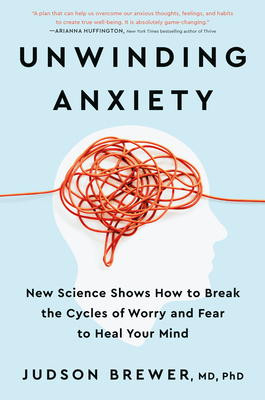
Key Insights & Memorable Quotes
The most popular highlights from Unwinding Anxiety, saved by readers on Screvi.
Worrying does not take away tomorrow’s troubles. It takes away today’s peace.
Notice how fear itself does not equal anxiety. Fear is an adaptive learning mechanism that helps us survive. Anxiety, on the other hand, is maladaptive; our thinking and planning brain spins out of control when it doesn’t have enough information.
Forgiveness is giving up hope of a better past.
RAIN Recognize what is happening right now. Allow/Accept it: Don’t push it away or try to change it. Investigate body sensations, emotions, thoughts: Ask, “Hmm, what is going on in my body right now?” Note what is happening in your experience.
Watch your thoughts. They become words. Watch your words. They become actions. Watch your actions. They become habits. Watch your habits. They become character.
A problem can’t be solved by the same consciousness that created it.
To artists, a block of clay says possibility. To travelers, a weekend promises adventure. To the nervous, that lack of structure screams anxiety.
If you really pay careful and close attention—without making any assumptions or relying on past experience to guide you—and you see that a behavior is not rewarding right now, I promise you that you will start to get less excited about doing it again.
The more inaccurate the information your PFC incorporates, the worse the outcome. And as the scenarios become more worst-case (which tends to happen as the PFC starts to go off-line, ironically due to the ramping up of the anxiety), your fight/flight/freeze physiology can get triggered to the point that just thinking about these possible (but highly improbable) situations can make you feel that you’re in danger, even though the danger is only in your head. Voilà! Anxiety.
Hate to also tell you this, but … your smartphone is nothing more than an advertising billboard in your pocket.
La ansiedad surge cuando nuestra corteza prefrontal no dispone de suficiente información para predecir el futuro con precisión.
Anxiety is born when our PFCs don’t have enough information to accurately predict the future
What are my top three habits and everyday addictions? What bad habits and unwanted behaviors do I keep doing, despite adverse consequences?
Importantly, like zebras who jump and kick, or dogs who shake their bodies after surviving stressful situations, you need to learn how to safely discharge the excess energy associated with that “I almost died” adrenaline surge, so that it doesn’t lead to chronic or post-traumatic stress and anxiety. Simply talking to someone doesn’t count here; you may really have to do something physical, like shout, shake, dance, or engage in some type of physical exercise.1 Your
mindfulness is about changing our relationship to those thoughts and emotions.
To hack our brains and break the anxiety cycle, we must become aware of two things: that we are getting anxious and/or panicking and what results from anxiety/panicking.
From cave people to scientists, our brains have never liked uncertainty. It feels scary. Uncertainty makes it difficult to predict what is going to happen. Both “Am I going to get eaten by a lion?” and “Is my scientific theory going to hold up?” register in roughly the same way in our brains, leading to a particular feeling: an urgency to act.
On top of this, because almost everything is readily available at a moment’s notice through our TVs, laptops, and smartphones, companies can take advantage of any weak moment (boredom, frustration, anger, loneliness, hunger) by offering a simple emotional fix (buy these shoes, eat this food, check this news feed). And these addictions get reified and solidified into habits, so that they don’t feel like addictions—they just feel like who we are.
Addiction isn’t limited to the so-called hard drugs and addictive substances. It is everywhere. Is this new, or had we missed something? The answer: this is old and new.
You see, anxiety hides in people’s habits. It hides in their bodies as they learn to disconnect from these feelings through myriad different behaviors
This is a crucial moment, so please read this slowly: With the same brain mechanisms as that unnamed cave person, we modern geniuses have gone from learning to survive to literally killing ourselves with these habits. And it’s gotten exponentially worse in the last twenty years.
mindfulness might actually give you more satisfying rewards, as in a substitute that has bigger, better rewards but without the baggage of feeding the craving
Since our brains will choose more rewarding behaviors simply because they feel better, we can practice replacing old habitual behaviors such as worry with those that are naturally more rewarding.
Like someone who has fallen into a raging river, worry calls to you to help from the shore. It frantically grabs on to your hand or leg, causing you to lose balance and get sucked into the rapids with it, or into a never-ending whirlpool of anxiety where you don’t know which way is up.
If you don’t believe me (or the data), try this: the next time you’re anxious, just tell yourself to calm down and see what happens. If you want an extra challenge, say the command in the stern tone of your parent’s voice.
Watch your thoughts. They become words. Watch your words. They become actions. Watch your actions. They become habits. Watch your habits. They become character. Watch your character. It becomes your destiny.
They become actions. Watch your actions. They become habits. Watch your habits. They become character. Watch your character. It becomes your destiny.
euphemisms
Observa tus pensamientos. Se transforman en palabras. Observa tus palabras. Se transforman en acciones. Observa tus acciones. Se transforman en hábitos. Observa tus hábitos. Se transforman en carácter. Observa tu carácter. Se transforma en tu destino.
What are my top three habits and everyday addictions? What bad habits and unwanted behaviors do I keep doing, despite adverse consequences
Find Another Book
Search by title or author to explore highlights from other books.
More Books You Might Like
Explore highlights from similar books.