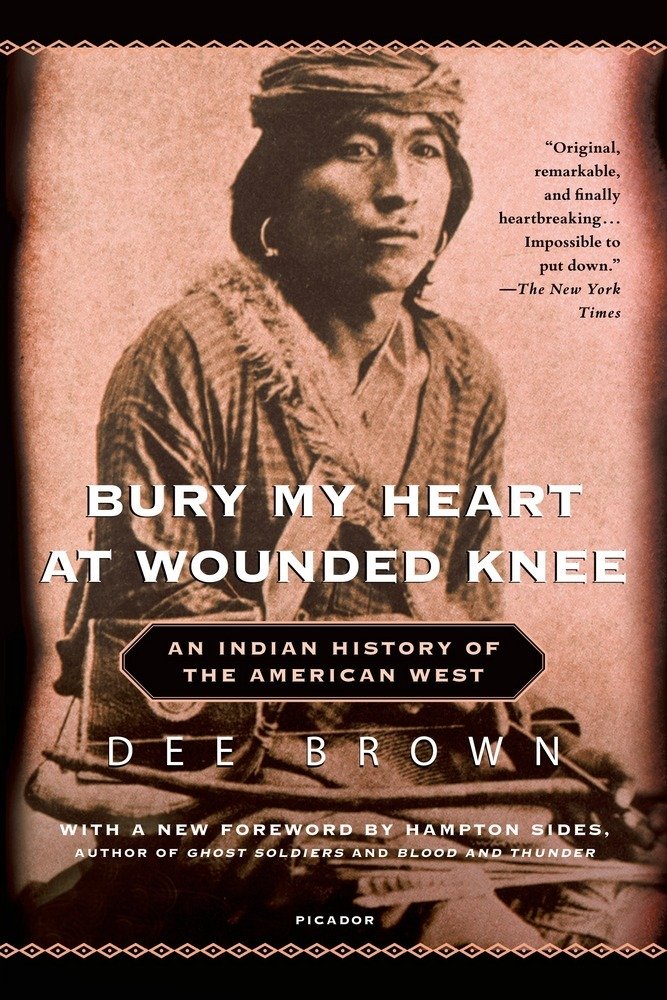
Key Insights & Memorable Quotes
The most popular highlights from Bury My Heart at Wounded Knee: An Indian History of the American West, saved by readers on Screvi.
“Nothing lives longOnly the earth and mountains”
“They made us many promises, more than I can remember, but they never kept but one; they promised to take our land, and they took it.”
“To the Indians it seemed that these Europeans hated everything in nature - the living forests and their birds and beasts, the grassy grades, the water, the soil, the air itself.”
“Treat all men alike.... give them all the same law. Give them all an even chance to live and grow. You might as well expect the rivers to run backward as that any man who is born a free man should be contented when penned up and denied liberty to go where he pleases. We only ask an even chance to live as other men live. We ask to be recognized as men. Let me be a free man...free to travel... free to stop...free to work...free to choose my own teachers...free to follow the religion of my Fathers...free to think and talk and act for myself.”
“I was born upon the prairie, where the wind blew free and there was nothing to break the light of the sun. I was born where there are no enclosures and where everything drew a free breath. I want to die there and not within walls. I know every stream and every wood between the Rio Grande and the Arkansas. I have hunted and lived over that country. I lived like my fathers before me, and, like them, I lived happily.Para-Wa-Samen (Ten Bears) of the Tamparika Comanches”
“The white people were as thick and numerous and aimless as grasshoppers, moving always in a hurry but never seeming to get to whatever place it was they were going to.”
“Another Chief remembered that since the Great Father promised them that they would never be moved they had been moved five times. "I think you had better put the Indians on wheels," he said sardonically, "and you can run them about whenever you wish.”
“Why do you not want schools?” the commissioner asked. “They will teach us to have churches,” Joseph answered. “Do you not want churches?” “No, we do not want churches.” “Why do you not want churches?” “They will teach us to quarrel about God,” Joseph said. “We do not want to learn that. We may quarrel with men sometimes about things on this earth, but we never quarrel about God. We do not want to learn that.”
“I want to say that further you are not a great chief of this country. That you have no following, no power, no control." Logan continued, "You are on an Indian reservation merely at the sufferance of the government. You are fed by the government, clothed by the government, your children are educated by the government, and all you have and are today is because of the government. If it were not for the government you would be freezing and starving today in the mountains. I merely say these things to notify you that you cannot insult the people of the United States of America or its committees ...the government feeds and clothes and educates your children now, and desires to teach you to become farmers, and to civilize you, and make you as white men.-Senator John Logan, 1883”
“On the mainland of America, the Wampanoags of Massasoit and King Philip had vanished, along with the Chesapeakes, the Chickahominys, and the Potomacs of the great Powhatan confederacy. (Only Pocahontas was remembered.) Scattered or reduced to remnants were the Pequots, Montauks, Nanticokes. Machapungas, Catawbas, Cheraws, Miamis, Hurons, Eries, Mohawks, Senecas, and Mohegans. (Only Uncas was remembered.) Their musical names remained forever fixed on the American land, but their bones were forgotten in a thousand burned villages or lost in forests fast disappearing before the axes of twenty million invaders. Already the once sweet-watered streams, most of which bore Indian names, were clouded with silt and the wastes of man; the very earth was being ravaged and squandered. To the Indians it seemed that these Europeans hated everything in nature—the living forests and their birds and beasts, the grassy glades, the water, the soil, and the air itself.”
“Not all of Anthony’s officers, however, were eager or even willing to join Chivington’s well-planned massacre. Captain Silas Soule, Lieutenant Joseph Cramer, and Lieutenant James Connor protested that an attack on Black Kettle’s peaceful camp would violate the pledge of safety given the Indians by both Wynkoop and Anthony, “that it would be murder in every sense of the word,” and any officer participating would dishonor the uniform of the Army.”
“When I was young I walked all over this country, east and west, and saw no other people than the Apaches. After many summers I walked again and found another race of people had come to take it. How is it? Why is it that the Apaches wait to die—that they carry their lives on their fingernails. They roam over the hills and plains and want the heavens to fall on them. The Apaches were once a great nation; they are now but few, and because of this they want to die and so carry their lives on their fingernails. Many have been killed in battle. You must speak straight so that your words may go as sunlight to our hearts. Tell me, if the Virgin Mary has walked throughout all the land, why has she never entered the wickiups of the Apaches? Why have we never seen or heard her?“I have no father nor mother; I am alone in the world. No one cares for Cochise; that is why I do not care to live, and wish the rocks to fall on me and cover me up. If I had a father and mother like you, I would be with them and they with me”
“In a short time a group of commissioners arrived to begin organization of a new Indian agency in the valley. One of them mentioned the advantages of schools for Joseph’s people. Joseph replied that the Nez Percés did not want the white man’s schools. “Why do you not want schools?” the commissioner asked. “They will teach us to have churches,” Joseph answered. “Do you not want churches?” “No, we do not want churches.” “Why do you not want churches?” “They will teach us to quarrel about God,” Joseph said. “We do not want to learn that. We may quarrel with men sometimes about things on this earth, but we never quarrel about God. We do not want to learn that.”
“I heard him call to the people not to be afraid, that the soldiers would not hurt them; then the troops opened fire from two sides of the camp.”
“And if the readers of this book should ever chance to see the poverty, the hopelessness, and the squalor of a modern Indian reservation, they may find it possible to truly understand the reasons why.”
“Already the once sweet-watered streams, most of which bore Indian names, were clouded with silt and the wastes of man; the very earth was being ravaged and squandered. To the Indians it seemed that these Europeans hated everything in nature-the living forests and their birds and beasts, the grassy glades, the water, the soil, and the air itself.”
“A short time later, near Gallina Springs, Graydon’s scouting party came upon the Mescaleros again. What happened there is not clear, because no Mescalero survived the incident.”
“Indians!" Sitting Bull shouted. "There are no Indians left but me!”
“When Joseph died on September 21, 1904, the agency physician reported the cause of death as “a broken heart.”
“mainland of America, the Wampanoags of Massasoit and King Philip had vanished, along with the Chesapeakes, the Chickahominys, and the Potomacs of the great Powhatan confederacy. (Only Pocahontas was remembered.) Scattered or reduced to remnants were the Pequots, Montauks, Nanticokes. Machapungas, Catawbas, Cheraws, Miamis, Hurons, Eries, Mohawks, Senecas, and Mohegans. (Only Uncas was remembered.) Their musical names remained forever fixed on the American land, but their bones were forgotten in a thousand burned villages or lost in forests fast disappearing before the axes of twenty million invaders. Already the once sweet-watered streams, most of which bore Indian names, were clouded with silt and the wastes of man; the very earth was being ravaged and squandered. To the Indians it seemed that these Europeans hated everything in nature—the living forests and their birds and beasts, the grassy glades, the water, the soil, and the air itself.”
“We rarely know the full power of words, in print or spoken.”
“The old men say the earth only endures. You spoke truly. You are right.”
“I shall not be there. I shall rise and pass. Bury my heart at Wounded Knee. —STEPHEN VINCENT BENET”
“Robert C. Winthrop says: “Professed patriotism may be made the cover for a multitude of sins.”
“it is better for both parties to come together without arms and talk it over and find some peaceful way to settle it. —SINTE-GALESHKA (SPOTTED TAIL) OF THE BRULÉ SIOUX”
“I now think a little powder and lead is the best food for them,” he concluded. 7”
“The white man knows how to make everything,” he said, “but he does not know how to distribute it.”
“Hinman believed that what the Indians needed was less land and more Christianity.”
“Such a development endangered the entire Indian policy of the government, which aimed to eradicate everything Indian among the tribes and make them over into white men.”
“The operations of General Hancock," Black Whiskers Sanborn informed the Secretary of the Interior, "have been so disastrous to the public interests, and at the same time seem to me to be so inhuman, that I deem it proper to communicate my views to you on the subject…For a mighty nation like us to be carrying on a war with a few straggling nomads, under such circumstances, is a spectacle most humiliating, an injustice unparalleled, a national crime most revolting, that must, sooner or later, bring down upon us or our posterity the judgment of Heaven.”
Find Another Book
Search by title or author to explore highlights from other books.
More Books You Might Like
Explore highlights from similar books.

Business Made Simple: 60 Days to Master Leadership, Sales, Marketing, Execution, Management, Personal Productivity and More
by Donald Miller

Busting Loose From the Money Game: Mind-Blowing Strategies for Changing the Rules of a Game You Can't Win
by Robert Scheinfeld

Buy Back Your Time: Get Unstuck, Reclaim Your Freedom, and Build Your Empire
by Dan Martell