Key Insights & Memorable Quotes
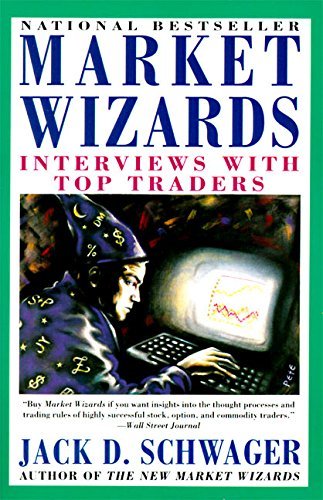
The most popular highlights from Market Wizards: Interviews with Top Traders, saved by readers on Screvi.
Another way to determine the direction of the general market is to focus on how the leading stocks are performing. If the stocks that have been leading the bull market start breaking down, that is a major sign the market has topped. Another important factor to watch is the Federal Reserve discount rate. Usually, after the Fed raises the rate two or three times, the market runs into trouble.
Actually, the best traders have no ego.
I figured out that for every dollar I made trading, 30 percent was going to the government, 30 percent was going to support my planes, and 20 percent was going to support my real estate. So I finally decided to sell everything.
If you don’t stay with your winners, you are not going to be able to pay for the losers.
Can you give me an example of how the lack of real world experience would hurt the researcher?
hold on to your winners and cut your losers.
Kovner lists risk management as the key to successful trading; he always decides on an exit point before he puts on a trade. He also stresses the need for evaluating risk on a portfolio basis rather than viewing the risk of each trade independently. This is absolutely critical when one holds positions that are highly correlated, since the overall portfolio risk is likely to be much greater than the trader realizes.
It is impossible to consistently outperform the market by using any information that the market already knows.
One of my rules was to get out when the volatility and the momentum became absolutely insane.
Charting is a little like surfing. You don’t have to know a lot about the physics of tides, resonance, and fluid dynamics in order to catch a good wave. You just have to be able to sense when it’s happening and then have the drive to act at the right time.
When I see a picture like the 1861 cotton market, I ask myself, “What caused that? Why did that happen?” Then I try to figure it out. From that, you learn an enormous amount. In
I feel my success comes from my love of the markets. I am not a casual trader. It is my life. I have a passion for trading. It is not merely a hobby or even a career choice for me. There is no question that this is what I am supposed to do with my life.
traders shouldn’t stick their heads in the sand and just hope it gets better.
Undertrade, undertrade, undertrade is my second piece of advice. Whatever you think your position ought to be, cut it at least in half. My experience with novice traders is that they trade three to five times too big.
What can a losing trader do to transform himself into a winning trader? A losing trader can do little to transform himself into a winning trader. A losing trader is not going to want to transform himself. That’s the kind of thing winning traders do.
Those who want to win and lack skill can get someone with skill to help them. I
Excessive worrying about taxes usually leads to unsound investments in the hope of achieving a tax shelter.
I am always thinking about losing money as opposed to making money.
One of the jobs of a good trader is to imagine alternative scenarios. I try to form many different mental pictures of what the world should be like and wait for one of them to be confirmed. You keep trying them on one at a time. Inevitably, most of these pictures will turn out to be wrong—that is, only a few elements of the picture may prove correct. But then, all of a sudden, you will find that in one picture, nine out of ten elements click. That scenario then becomes your image of the world reality.
Albert Einstein said that the single most important question is whether the universe is friendly. I think it is important for everybody to come to a point where they feel inside that the universe is friendly.
Whenever I enter a position, I have a predetermined stop.
Almost anybody can make up a list of rules that are 80 percent as good as what we taught our people. What they couldn’t do is give them the confidence to stick to those rules even when things are going bad.
Place your stops at a point that, if reached, will reasonably indicate that the trade is wrong, not at a point determined primarily by the maximum dollar amount you are willing to lose per contract. If the meaningful stop point implies an uncomfortably large loss per contract, trade a smaller number of contracts.
Unlike some other gurus, he doesn’t believe he is predicting the future; he is simply observing what is happening and making rational bets.
I learned that if you shoot for what you want, you stand a much better chance of getting it because you care much more.
Another thing is that if a position doesn’t feel right as soon as you put it on, don’t be embarrassed to change your mind and get right out.
The first thing I would say is always bet less than 5 percent of your money on any one idea.
The next thing I would advise is to always use stops.
there is probably no class of trades with a higher failure rate than impulsive (not to be confused with intuitive) trades.
You have to be willing to make mistakes regularly; there is nothing wrong with it.
Find Another Book
Search by title or author to explore highlights from other books.
More Books You Might Like
Explore highlights from similar books.

Marriage, a History: From Obedience to Intimacy or How Love Conquered Marriage
by Stephanie Coontz

Mastering Bitcoin: Unlocking Digital Cryptocurrencies
by Andreas M. Antonopoulos

Mastering The Market Cycle: Getting the Odds on Your Side ― Legendary Investor Howard Marks's NYT Bestselling Investment Guide on Market Cycles
by Howard Marks