Key Insights & Memorable Quotes
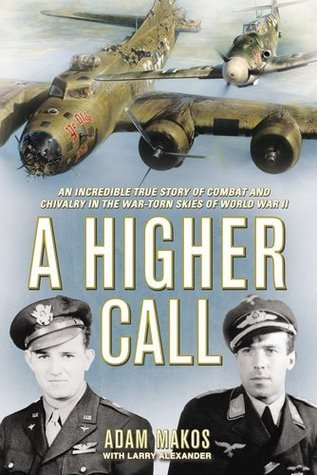
The most popular highlights from A Higher Call: An Incredible True Story of Combat and Chivalry in the War-Torn Skies of World War II, saved by readers on Screvi.
Franz’s father gave him a lesson. “Always do the right thing, even if no one sees it.
Von Faulhaber had authored “With Burning Concern” in 1937, and in 1941, von Galen had spoken out so vehemently against The Party and the Gestapo that the British had copied his sermons and dropped them from planes across Europe.* German soldiers, civilians, and occupied peoples read them, including the future Pope John Paul II, who found a flyer in Krakow, Poland.
Of the twenty-eight thousand German fighter pilots to see combat in WWII, only twelve hundred survived the war.
You fight by rules to keep your humanity
Don't worry," he said. "We fight our best when we're losing.
Can good men be found on both sides of a bad war?
Vatican’s secretly composed message to all of Germany’s Catholics. On Palm Sunday, 1937, the letter had been read by every priest, bishop, and cardinal across Germany to their congregations and three hundred thousand copies had been disseminated. Drafted by Munich’s Cardinal von Faulhaber and Pope Pius XI, it told German Catholics in carefully veiled terms that National Socialism was an evil religion based on racism that stood contrary to the church’s teachings and every man’s right to equality. It made reference to “an insane and arrogant prophet” without naming Hitler.
Harper unlocked a drawer in his desk and removed a bottle of Vat 69 whiskey and two shot glasses. He uncorked the bottle while explaining that policy permitted him to give each crewman a shot to loosen his tongue before reviewing a tough mission.
Keep the quotes that hit you. Save them to Screvi with this book's top highlights.
Save freethe twenty-eight thousand German fighter pilots to see combat in WWII, only twelve hundred survived the war.
they knew that you would someday read this book, even if they were not around to read the final copy themselves. This book is their gift to us.
plenty of questions about the prudence of war and the person we call the enemy. But mostly it begs a question of goodness.
Hitler and The Party took over Germany after 56 percent of the country had voted against them.
Their code said to fight with fearlessness and restraint, to celebrate victories not death, and to know when it was time to answer a higher call.
When I first phoned the World War II bomber pilot named Charlie Brown, all I wanted was thirty minutes of his time. But what I found was a beautiful story worth every minute of eight years.
on
Their code said to fight with fearlessness and restraint, to celebrate victories not death, and to know when it was time to answer a higher call. Franz gazed at the men in the waist tending one another’s wounds. He looked into the ashen face of the ball turret gunner. He thought about what his brother August would have done. A gear clicked in Franz’s soul. He laid a hand over the pocket of his jacket and felt his rosary beads within. This will be no victory for me, Franz decided. I will not have this on my conscience for the rest of my life.1
Keep the quotes that hit you. Save them to Screvi with this book's top highlights.
Save freeFranz tipped his wing and looked down on the P-38 he had wounded. It was circling downward, its engine coughing black smoke. Suddenly the hood of its canopy tumbled away in the slipstream. The pilot stood in the cockpit then dove toward the rear of the wing. The draft sucked his body under the forked tail. He free-fell from twelve thousand feet, passing through the clouds. “Pull it!” Franz shouted at the American, urging him to open his chute. When the pilot’s parachute finally popped full of air, Franz felt relief. The pilot drifted lazily downward while his P-38 splashed into the sea. Franz flew lower and saw the P-38 pilot climb into a tiny yellow raft against the whitecaps. Franz radioed Olympus to tell them to relay the American’s position to the Italians. He guessed they were seventy kilometers west of Marettimo and asked if the island could send a boat to pick up the man. For a second, Franz considered hovering over the man in the raft like an aerial beacon to steer a boat to the spot, but he shook the thought from his mind. It would put him at risk. If a prowling flight of enemy fighters found him, Franz knew he, too, could be shot into the sea. Franz and Willi departed the scene, leaving the pilot in his raft to fate. As they flew away, Franz wished the man a strong westerly wind. The American who looked up from the raft was Second Lieutenant Conrad Bentzlin, a young man from a large Swedish-American family in Saint Paul, Minnesota. He was quiet and hardworking, having taught himself English in high school. He had paid his way through the University of Minnesota by working for the government’s Civilian Conservation Corps program, cutting firebreaks in the forests of northern Minnesota. Among his buddies of the 82nd Fighter Group, Bentzlin was known as “the smartest guy in the unit.” Far from shore Bentzlin floated alone. A day later, another flight of P-38s flew over him and, through a hole in the clouds, saw him waving his arms from a raft. But he was in the middle of the sea and they could do nothing. Bentzlin would never be seen again.*
It took some time for him to revisit the VA hospital... but he did.Clarence approached the conference room's open door. Familiar, upbeat voices poured forth; another group therapy session was about to commence.This time around, a different Clarence Smoyer paced those sterile hallways. A survivor.He had faced his PTSD and emerged victorious.Talking about it, with someone who listened and understood, had saved him. And maybe that's what those younger veterans needed to hear. Maybe he could encourage them to keep talking. Or maybe he could be that someone who would listen.When Clarence reached the open doorway, he didn't slow his step, or pause beyond sight.There was no turning back from what he'd come to do.'Someone has to help those guys.'Clarence stepped inside.
There’s holes in the fuselage big enough to climb through,
As the throbbing plane warmed up Charlie silently prayed, or, as he referred to it, conducted "a short briefing with my third pilot.
A blast of heat hit his face. He flopped onto his cot, closed his eyes, and fell into an instant sleep. In the evening he went to the mess tent. He passed through the line and saw that dinner was the same as lunch—a tin of Italian beef his comrades called “Mussolini’s Ass.” Back home Franz had been picky and would tell his mother, “I’ll pass on anything that flies or swims.” Little did he know how he would come to regret those words.
although quick to smile.
Although he never spoke of his war stories, he told Franz something he would never forget."Don't worry," he said. "We fight our best when we're losing.
Hitler and Goering are standing atop the Berlin radio tower. Hitler says he wants to do something to put a smile on Berliners’ faces. So Goering says: ‘Why don’t you jump?
Keep the quotes that hit you. Save them to Screvi with this book's top highlights.
Save freeYou follow the rules of war for you, not for your enemy,” Roedel said. “You fight by rules to keep your humanity.
rudder was nearly gone. He told Charlie the tail gunner’s position was shattered.
grabbed his shoes, and left the hut without his coat.*
holes. Only their heads showed as they nervously
Its spinner was black and had a swirling white
Find Another Book
Search by title or author to explore highlights from other books.
More Books You Might Like
Explore highlights from similar books.