Key Insights & Memorable Quotes
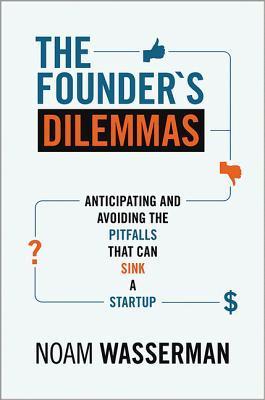
The most popular highlights from The Founder's Dilemmas: Anticipating and Avoiding the Pitfalls That Can Sink a Startup, saved by readers on Screvi.
A friendship built on business can be glorious, while a business built on friendship can be murder.
Thanks to conflict avoidance, path dependence, natural biases, and ignorance of the long-term consequences of their decisions, founders often take actions that diverge considerably from what they should do.
IT’S UNFORTUNATE BUT TRUE: IF ENTREPRENEURSHIP IS A BATTLE, most casualties stem from friendly fire or self-inflicted wounds.
What they don’t teach you in business school is to make sure your life partner is in sync with what you’re doing,
Many entrepreneurs work in highly uncertain and “noisy” environments in which feedback is ambiguous and based on uncertain evidence. Such environments render people especially susceptible to cognitive biases and errors, including overconfidence,12 and to following their instincts, the one “input” that does seem clear.
Aside from the parent-child relationship, we do not expect our relatives and friends to have any more power over us than we grant them out of respect or affection.
A decision made at one point can make a subsequent decision turn out badly, even if that subsequent decision might have turned out well in different circumstances.
Too much hubris, confidence, and passion can hinder a founder from exploring alternative approaches and making necessary adjustments.
Keep the quotes that hit you. Save them to Screvi with this book's top highlights.
Save freeA friendship built on business can be glorious, while a business built on friendship can be murder.” Where
Studies of cash compensation in large companies consistently find a “gender gap”; that is, 20% to 25% lower compensation for women.
Likewise, founders’ natural biases—toward optimism over realism, toward instinct over systematic planning, toward strong attachment to their ideas, their startups, and their employees over dispassionate reasoning—often turn on them.
Founders who consistently make decisions that build wealth are more likely to achieve what I call a “Rich” outcome (greater financial gains, lesser control), while founders who consistently make decisions that enable them to maintain control of the startup are more likely to achieve what I call a “King” outcome (greater control, lesser financial gains).* Multiple
Many idea people assume that they deserve to be CEO, regardless of whether they are true CEO material.
Short-term versus Long-term Consequences An “easy” short-term decision may introduce long-term problems; a “hard” short-term decision may often be best in the long run. Conflict avoidance often leads founders to make easy short-term decisions; they succumb to the temptation to sidestep or postpone acknowledging—not to mention resolving—these dilemmas, especially if coming to a decision would require difficult conversations about what could go wrong.
Founding a startup is akin to a wedding, a declaration of mutual devotion. It seems inappropriate and even counterproductive to plan for a breakup, yet in entrepreneurship, failing to make the prenup part of the wedding vows, so to speak, can prove disastrous.
Multiple studies have confirmed that these two motivations are the most common. In the Kauffman Foundation’s study of 549 founders of American technology startups, 75% of the respondents said that building wealth was a very important motivation for becoming an entrepreneur and 64% said the same of wanting to own their own businesses.16 Likewise, the Panel Study of Entrepreneurial Dynamics asked 1,214 respondents about their motives for starting a business. The top six motivations were control motivations, such as freedom to take one’s own approach to work and fulfilling a personal vision, and wealth-building motivations, such as gaining financial security and building great wealth.17 The CareerLeader
Keep the quotes that hit you. Save them to Screvi with this book's top highlights.
Save freeSetting the early equity split in stone, without allowing for changes, is one of the biggest mistakes founders can make.
Teams of prior coworkers were significantly more stable than both teams who had a prior social relationship and teams of strangers.
All told, entrepreneurs earned 35% less over a 10-year period than they could have earned in a “paid job.”24 The authors of these studies therefore wondered why so many intelligent people would wish to play this game if there is indeed no “private-equity premium.
ideas are cheap; execution is dear.
Conflict avoidance often leads founders to make easy short-term decisions; they succumb to the temptation to sidestep or postpone acknowledging—not to mention resolving—these dilemmas, especially if coming to a decision would require difficult conversations about what could go wrong.
All told, entrepreneurs earned 35% less over a 10-year period than they could have earned in a “paid job.
The most effective boards give independent, informed advice to management and challenge the CEO, rather than acting as a rubber stamp.”40 Ideally, says one VC, “Boards should be encouraging the type of learning to allow a company to ‘pivot’ by making important changes in its strategy.” To the extent that some founders have trouble focusing on a single idea rather than pursuing new projects, boards can also serve as a check on that tendency.
The best way to evaluate such compatibility is often to “try before you buy” by finding self-contained work tasks on which to collaborate before committing to be cofounders—a commitment that is very unpleasant to reverse.
Keep the quotes that hit you. Save them to Screvi with this book's top highlights.
Save freeAs Bagley and Dauchy suggest, “The most effective boards give independent, informed advice to management and challenge the CEO, rather than acting as a rubber stamp.”40 Ideally, says one VC, “Boards should be encouraging the type of learning to allow a company to ‘pivot’ by making important changes in its strategy.” To the extent that some founders have trouble focusing on a single idea rather than pursuing new projects, boards can also serve as a check on that tendency.
depth of knowledge is important, but people who have depth without breadth do not become the sort of jack-of-all-trades that a founder needs to be.39
Find Another Book
Search by title or author to explore highlights from other books.
More Books You Might Like
Explore highlights from similar books.